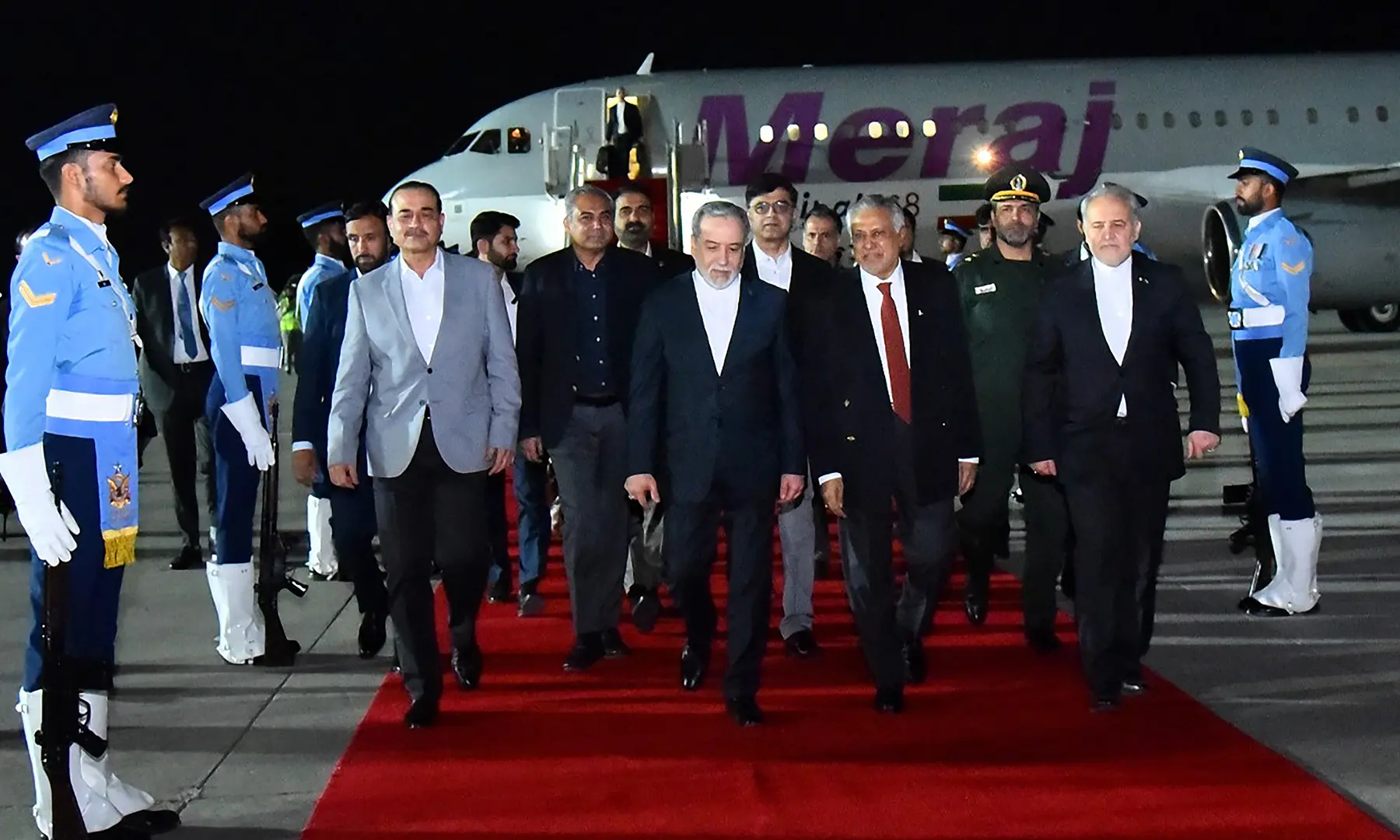
Iranian Delegation Lands in Islamabad
He Has Landed — And This Time, the World Was Watching the Runway
There are diplomatic arrivals, and then there are moments. When Iran's Foreign Minister Abbas Araghchi touched down at Nur Khan Air Base in Rawalpindi on the night of April 24, 2026, it was very clearly the second kind.
He was not met by a protocol officer with a bouquet and a handshake. He was not greeted by a mid-level ministry official following standard diplomatic procedure. Standing on the tarmac to receive him personally were two of the most powerful figures in Pakistan's government — Deputy Prime Minister and Foreign Minister Ishaq Dar, and Army Chief Field Marshal Asim Munir. That level of reception, for a foreign minister arriving for what Iran was publicly describing as merely "bilateral consultations," told you everything you needed to know about the real weight of this moment before a single word of any meeting had been exchanged.
Ishaq Dar posted on X shortly after the arrival, calling Araghchi his "brother" and expressing anticipation for "meaningful engagements aimed at promoting regional peace and stability." The language was warm, personal, and deliberately measured — saying enough to signal that this was significant without getting ahead of what had actually been confirmed. That balance between signal and restraint is something Pakistan has gotten very good at managing throughout this entire process.
For anyone who has been following the story of Pakistan's mediation between the United States and Iran since the Islamabad talks of April 11 and 12, Araghchi's return to Islamabad was not entirely surprising. But it was still, in the context of everything that had happened in the two weeks between that first round and this moment, a genuinely remarkable development.
The Two Weeks That Almost Broke Everything
To understand why Araghchi getting on a plane to Islamabad on April 24 mattered so much, you need to understand how bad things looked in the days between the first round of talks and this visit. Because it was bad. Genuinely, seriously bad — the kind of bad that makes experienced diplomats lose sleep and makes ordinary observers wonder if the whole process was about to collapse entirely.
The first round of US-Iran talks in Islamabad ended on April 12 without a deal. That was not entirely unexpected — nobody who understood the depth of the issues involved was expecting a comprehensive agreement to emerge from a first meeting after 47 years of diplomatic silence between the two countries. But what happened the next day made everything suddenly much more precarious.
On April 13, the United States imposed a naval blockade on Iran. Whatever momentum had been built through the Islamabad talks, whatever goodwill had been generated by two sides actually sitting in the same room for 21 hours — a significant portion of it evaporated overnight with that announcement. Iran's response was swift and predictable. Tehran closed the Strait of Hormuz. Oil markets jolted. The fragile ceasefire that Pakistan had helped put in place looked suddenly very vulnerable.
For nearly two weeks after that, a second round of talks looked genuinely uncertain. Iran had been explicit — President Pezeshkian had said it directly to Prime Minister Shehbaz Sharif in a phone call — that meaningful negotiations could not happen while the blockade remained in place. The United States, with Trump publicly saying America "has all the cards," did not appear to be in a hurry to make concessions that would bring Iran back to the table. And at one point, news came through that Trump had cancelled a planned US delegation visit to Pakistan entirely, citing doubts about whether the talks would produce meaningful results.
For a process that Pakistan had invested enormous diplomatic capital in building, those two weeks were the real test. Not the first round, which went relatively smoothly — but the period after, when everything seemed to be pulling apart and the question was whether the whole thing would survive.
Pakistan Went Back to Work
This is the part of the story that does not always get the attention it deserves, because it happened quietly and without the kind of dramatic headlines that a summit meeting or a formal announcement produces. But it is probably the most important part.
While the public picture of the US-Iran diplomatic process looked bleak — cancelled visits, hardened positions, public statements from both sides that seemed to be moving away from rather than toward each other — Pakistan did not step back. It did not accept the impasse as settled. It went back to work.
Field Marshal Asim Munir got on the phone with Araghchi directly. Not a junior official relaying a message. Not a written communication through formal diplomatic channels. A direct conversation between Pakistan's most senior military officer and Iran's most experienced diplomat, aimed at finding out whether there was any pathway back to engagement that the public statements were not reflecting.
Ishaq Dar did the same. He called Araghchi. He maintained the personal relationship that had been built through the first round of talks and kept the line of communication open during a period when many observers were writing off the prospect of a second round.
And it worked. The result of those calls — of that persistent, patient, behind-the-scenes engagement — was Araghchi boarding a plane to Islamabad. The city that Iran had said, explicitly and publicly, it trusts more than any other for this process. Pakistan's ability to bring both sides back after a rupture as significant as the one that followed the blockade announcement is, by any reasonable assessment, a remarkable diplomatic achievement that goes beyond what the formal descriptions of Pakistan's "mediating role" fully capture.
What Iran Said Publicly — And What It Actually Meant
Iran's public communications around this visit followed a pattern that anyone who has been paying close attention to Tehran's diplomatic style throughout this process would recognise immediately.
Iran's state news agency IRNA described Araghchi's visit to Islamabad as being for "bilateral consultations with Pakistani officials" — not for direct talks with the United States. Iran's Foreign Ministry spokesperson Esmaeil Baghaei posted on X that there were no plans for a meeting between Iranian and US negotiators, saying Iran's observations would be conveyed to Pakistan first, and that any further steps would depend on the results of those conversations.
Read that carefully and you see exactly what Iran was doing. It was preserving the public position — that it is not negotiating directly with America under current conditions — while simultaneously sending its most senior diplomat to the city where America's negotiating team was about to arrive. The framing allows Tehran to maintain domestic credibility with audiences who are skeptical of any engagement with Washington, while in practice moving the process forward in ways that those same audiences cannot easily see or object to.
This is not unique to Iran — sophisticated diplomatic actors frequently manage the gap between public statements and private reality in exactly this way. The public position is designed for domestic consumption and for maintaining negotiating leverage. The private movement is where the actual diplomacy happens. What made this particular example notable was how explicit the gap was — Iran was officially saying there would be no direct talks at the exact moment its foreign minister was flying to the city where direct talks were clearly about to happen.
Pakistani officials, who have been navigating this gap between Iranian public statements and Iranian private movement throughout the entire process, were not caught off guard by any of this. They had seen the same dynamic before the first round of talks, when Iran was publicly skeptical about attending right up until its 70-member delegation landed in Islamabad. The pattern was familiar. The response was the same — say what needs to be said publicly, keep the process moving privately, and let the facts on the ground eventually speak for themselves.
Meanwhile, Washington Was Already Packing Its Bags
While Iran was carefully managing its public messaging to downplay the prospect of direct engagement, the White House was telling a noticeably different story — and not through diplomatic back channels but on national television.
White House Press Secretary Karoline Leavitt confirmed on Fox News that US Special Envoy Steve Witkoff and President Trump's adviser Jared Kushner would fly to Pakistan on Saturday morning to engage in direct talks with the Iranian delegation. That is not the kind of confirmation you make on live television if you are not confident the meeting is actually going to happen. The White House was sending a clear signal to anyone paying attention that this was real, it was happening, and Washington was taking it seriously.
Leavitt added something that directly contradicted Iran's public framing — she said the Iranians themselves had requested the in-person conversation. If that is accurate, it means that whatever Iran was saying publicly about not planning direct talks, at least one part of the Iranian government had reached out to request exactly that. The gap between the public position and the private request, if Leavitt's account is correct, was not just significant — it was total.
She also said the US was hopeful the talks would "move the ball forward towards a deal." That phrase — move the ball forward — is deliberately modest. Nobody was claiming a breakthrough was imminent or that a comprehensive agreement was on the table. But the direction of travel that the language implied was positive, and the willingness to send Witkoff and Kushner — two of Trump's most trusted personal envoys on this file — suggested that Washington's investment in the process had not disappeared with the cancelled delegation announcement from earlier in the week.
Vice President JD Vance, who had led the American team in the first round of Islamabad talks, was not travelling for this visit. But his office confirmed he remained deeply involved in the process and was on standby to join if talks progressed to a point where his presence would be useful. That kind of senior-level availability as a potential escalation option is itself a signal — it says that if the conversation gets serious enough, America is prepared to send the person who has already sat across from Iran's delegation and talked for 21 hours.
The Infrastructure Pakistan Had Ready Before Anyone Arrived
One of the details that came out around Araghchi's arrival was something that put the entire preparation in striking relief — a US logistics and security team had already been in Islamabad for days before the Iranian foreign minister landed. At least nine American aircraft had touched down in the city during the preceding week, carrying vehicles, communications equipment, security personnel, and technical staff.
Two hotels in Islamabad's Red Zone had been kept closed and held on standby specifically for the delegations. Not temporarily closed for a renovation or for an unrelated event — held empty and ready, for days, waiting for this moment.
Think about what that means operationally. Pakistan did not wait for both sides to confirm they were coming before beginning preparations. It began preparing on the assumption that the process would succeed — that the phone calls being made, the private conversations being held, and the persistent diplomatic work being done behind the scenes would eventually produce the result of both parties coming back to Islamabad. It made a bet on its own diplomacy and invested real resources in being ready when that diplomacy worked.
Interior Minister Mohsin Naqvi confirmed publicly that Prime Minister Shehbaz Sharif and Field Marshal Asim Munir had been making full efforts at every level to bring both sides together. That confirmation, given in the context of Araghchi's arrival and the imminent arrival of the American team, was an explicit acknowledgment of just how much work had gone into making this moment possible.
Pakistan's role as the trusted middle ground between Washington and Tehran has never been more visible to the outside world than it was on the night of April 24. The scale of the preparation, the level of the officials who received Araghchi at the airport, the presence of American infrastructure already in place in the city — all of it together painted a picture of a country that had earned the trust of both sides through sustained, serious, and remarkably effective diplomatic work.
Who Araghchi Is — And Why His Presence Matters
It is worth taking a moment to understand who Abbas Araghchi actually is in the context of Iranian diplomacy, because his personal presence leading the Iranian side of this process is not a routine detail. It is a significant signal about Iran's level of engagement.
Araghchi is not a figure-head minister who shows up for photo opportunities and leaves the real work to subordinates. He is Iran's most experienced and most capable diplomat on nuclear and international security issues — the person who led Iran's negotiating team through the painstaking, years-long process that produced the 2015 Joint Comprehensive Plan of Action, better known as the Iran nuclear deal. That agreement, whatever its subsequent fate, was one of the most complex multilateral diplomatic achievements in recent international history. Araghchi was at the centre of it.
His appointment as Foreign Minister gave him the formal authority to match his substantive expertise. And his personal involvement in the Islamabad process — flying to Pakistan, engaging directly with Pakistani officials, being prepared to be in the same city as the American negotiating team — signals that Iran, at least at the level of its foreign ministry, is taking this process seriously and has sent the person most capable of finding a workable outcome if one is available to be found.
Pakistani officials who have worked with Araghchi through this process have noted that he is more pragmatic and more focused on finding workable solutions than some of the harder-line figures in Tehran who are skeptical of any engagement with America. That assessment matters because the challenge in Iranian diplomacy is not just what happens at the negotiating table — it is whether the person at the table has enough political standing and internal credibility to deliver an agreement that can survive the scrutiny of Iran's complex domestic political environment.
Araghchi's history with the 2015 deal, and his continued standing in Iranian political circles despite the turbulent years that followed that agreement, suggests he has the combination of experience and credibility that a process of this difficulty requires on the Iranian side.
The Itinerary After Islamabad — What It Reveals
One detail in the reporting around Araghchi's visit that deserves more attention than it initially received is his planned itinerary after leaving Islamabad. He was scheduled to travel next to Muscat in Oman, and then to Moscow in Russia.
The significance of that sequence is easy to miss but worth spelling out. Oman has been a long-standing and important back channel in US-Iran relations — it is the country through which much of the quiet, unofficial communication between Washington and Tehran has flowed over many years, including during the period that eventually led to the 2015 nuclear deal. Araghchi visiting Muscat after Islamabad suggests that the Omani channel remains active as a parallel track to the Pakistan-mediated process, which is consistent with how these kinds of complex multilateral diplomacy efforts typically work — multiple channels running simultaneously, reinforcing and cross-checking each other.
Moscow is a different kind of signal. Russia has its own strategic interests in how the Iran-US conflict resolves — it has been a beneficiary of the pressure on Iran's oil exports in some ways, while also having its own significant relationships with Tehran that make a stable Iran important to Russian interests. Araghchi visiting Moscow suggests that Iran is coordinating its diplomatic positioning not just with Pakistan and Oman but also with Russia, whose influence over the broader regional security environment is substantial and whose support — or at least acquiescence — may be important for any eventual agreement.
But the critical detail in this itinerary is the order. Islamabad first. Before Muscat. Before Moscow. Iran chose to come to Pakistan before going anywhere else on what appears to be a significant regional diplomatic tour. That sequence is not accidental, and it reflects something real about where Iran believes the most important diplomatic action is happening right now. Pakistan is the priority stop. Everything else comes after.
The Unresolved Issues — What the Second Round Has to Deal With
The optimism surrounding Araghchi's return to Islamabad and the imminent arrival of Witkoff and Kushner should not obscure the fact that the issues that prevented a deal in the first round have not magically resolved themselves in the two weeks between then and now. They are still there, still difficult, and still capable of blocking progress if the conversations do not go well.
Iran's nuclear programme is the central issue that has defined the US-Iran relationship for two decades. The United States wants verifiable limits on Iran's uranium enrichment capacity and its ability to develop nuclear weapons. Iran insists on its right to a civilian nuclear programme and has consistently resisted limits that it regards as discriminatory or as incompatible with its sovereignty. The technical details of any agreement on this issue are enormously complex, and the political sensitivities on both sides are correspondingly enormous.
The naval blockade that the United States imposed on April 13 has become an acute and immediate issue overlaid on the longer-term nuclear question. Iran has made it clear that it regards the blockade as an active pressure measure incompatible with good-faith negotiations. The United States has framed the blockade as a legitimate response to Iran's actions. Resolving or at least managing this immediate flashpoint is probably a precondition for getting to the deeper structural conversations about nuclear issues and sanctions.
Sanctions relief is another central issue. Iran wants the removal or significant easing of the comprehensive sanctions regime that has been strangling its economy. The United States wants to maintain sanctions leverage until Iran makes verifiable commitments on the nuclear programme. The sequencing question — who moves first, and how much verification is required before relief is provided — has derailed negotiations before and is likely to be a central point of contention in any second-round discussions.
Frozen assets — Iranian funds held in various international accounts that have been blocked by sanctions — represent a significant financial issue that is both substantively important and politically charged. Previous partial releases of frozen assets have been used by the US as goodwill gestures in negotiating processes and have been deeply controversial in American domestic politics. The fate of those assets will be part of any comprehensive negotiation.
None of these issues is easy. All of them have deep roots in the history of the US-Iran relationship and in the domestic politics of both countries. Getting to a deal on any of them, let alone all of them, will take time, patience, creativity, and a degree of political courage on both sides that is not guaranteed to be available. But the fact that both sides are in Islamabad, in whatever formal or informal configuration the meetings take, means the conversations at least have a chance to move forward in ways that they cannot when the two sides are not in the same place.
Pakistan at the Centre — Again, and Again
Whatever happens in the specific conversations between Araghchi and the American team during this visit, the broader story of what Pakistan has achieved through this entire process is already clear enough to assess.
Pakistan hosted the first direct US-Iran talks in 47 years in April. It absorbed the shock of the blockade announcement and the subsequent near-collapse of the diplomatic process without walking away. It made the phone calls that brought Araghchi back to Islamabad. It had the hotels ready, the security in place, and the senior officials on the tarmac when the plane landed. It is doing all of this while managing its own significant domestic challenges, while playing a parallel role in the broader regional security environment, and while maintaining relationships with both Washington and Tehran that most countries in the world would consider impossible to hold simultaneously.
Interior Minister Naqvi's public acknowledgment that PM Shehbaz and Field Marshal Munir have been working "at every level" to bring both sides together was more than a political statement for domestic consumption. It was an accurate description of what has actually been happening — an extraordinary level of personal engagement by Pakistan's most senior leaders in one of the most difficult diplomatic challenges of the current moment in international affairs.
The fact that Araghchi came to Islamabad first — before Muscat, before Moscow, before anywhere else — is the clearest possible evidence of how both Iran and the international diplomatic community are assessing Pakistan's role right now. You go first to the place where you believe the most important conversations can happen. Iran believed that was Islamabad. That belief is a product of everything Pakistan has done to earn it over the preceding months.
What the Coming Days Will Determine
The meetings that follow Araghchi's arrival — whether they are formally direct US-Iran talks or whether they happen through the Pakistan-mediated format of the first round, or some combination of both — will determine whether the momentum of this visit translates into something more durable than the first round produced.
A second round of talks that makes meaningful progress on even one of the major outstanding issues would be a genuine achievement. A second round that produces a framework or a roadmap for continuing the process — even without a final deal — would keep the diplomatic track alive and give both sides something to build on. A second round that collapses or ends in acrimony would set the process back significantly and raise serious questions about whether a diplomatic solution is achievable at all in the near term.
Pakistan, for its part, will be doing what it has done throughout — facilitating, managing, keeping the lines of communication open, and trying to help both sides find enough common ground to justify continuing a conversation that neither side would be having without Islamabad's sustained and remarkable diplomatic effort.
JD Vance is on standby. The American team is in the air. Araghchi is already in Islamabad. The hotels are open. Pakistan is ready.
Final Thoughts
History does not always announce itself clearly in the moment. Sometimes it is only in looking back that the significance of a particular night, a particular arrival, a particular set of conversations becomes fully visible.
But some moments are clear enough even as they are happening. The night of April 24, 2026, when Iran's foreign minister landed at Nur Khan Air Base and was personally received by Pakistan's deputy prime minister and army chief, while American aircraft already sat on Islamabad's tarmac and hotel rooms in the Red Zone waited for delegations that were hours away — that was one of those moments.
Two countries that have been enemies for nearly half a century are meeting, again, in Pakistan's capital. Pakistan brought them here the first time. Pakistan brought them back after a rupture that could have ended the whole process. Whatever the coming days produce, Islamabad has already done something that no other country was willing or able to do — kept a fragile, difficult, enormously consequential diplomatic process alive when everything was pulling it apart.
The world is watching. And for once, the world is watching Islamabad with something that looks very much like genuine respect.