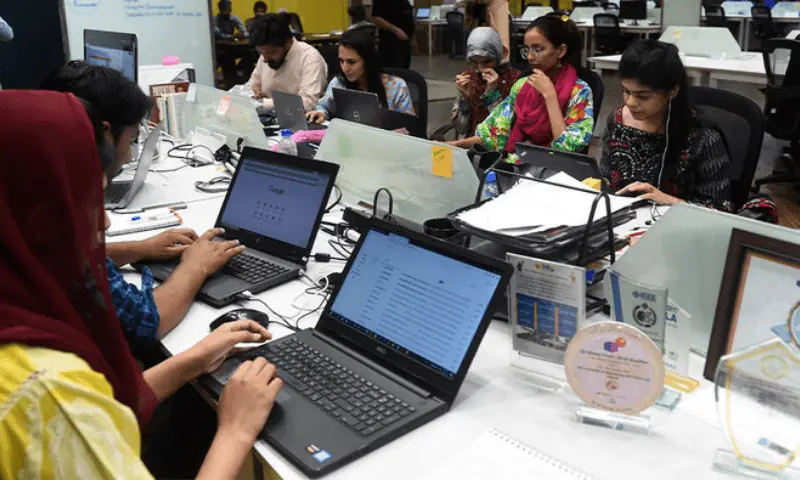

Pakistan's Startup Ecosystem in 2026 — From Emerging Market to Performance Phase
ISLAMABAD — Pakistan's startup ecosystem has entered a critical new phase in 2026, transitioning from an emerging narrative to one defined by measurable performance, maturing business models, and selective but significant investor confidence. With a combined enterprise valuation surpassing billion — a 3.6-fold increase since 2020 — the ecosystem is demonstrating resilience that few predicted just a few years ago.
A New Era of Funding Discipline
The first quarter of 2026 saw 3.5 million raised across five equity funding rounds, signaling continued investor interest in Pakistani startups. However, the nature of funding has changed dramatically. Gone are the days of easy venture capital chasing growth at any cost. Today's investors demand strong fundamentals, capital efficiency, and clear paths to profitability.
A significant trend reshaping the landscape is the adoption of hybrid financing models combining equity and debt. This approach, which became mainstream in 2025, has enabled a broader range of startups to secure financing while preserving founder equity. Industry analysts expect this trend to continue, as investors seek to balance risk and return in a still-developing market.
Leading the charge is Haball, a B2B fintech platform that secured a landmark 2 million hybrid round in 2025 and is now eyeing regional expansion. The company exemplifies the new generation of Pakistani startups — revenue-focused, solving real problems, and building sustainable business models rather than chasing vanity metrics.
Sectoral Breakdown — Where the Money Is Going
Fintech continues to dominate the investment landscape, attracting the largest share of venture capital. The sector's success stems from its ability to integrate with traditional banking infrastructure, simplify digital payments, and serve an underserved market of small and medium enterprises and digital consumers. With only 20 percent of adults having access to formal banking services, the addressable market remains enormous.
Healthtech has emerged as a strong growth engine in 2026, with significant investor interest in solutions addressing healthcare accessibility and quality in both urban and rural markets. Startups leveraging telemedicine platforms, AI-powered diagnostics, and pharmacy delivery networks have gained particular traction. The COVID-19 pandemic permanently shifted consumer behavior toward digital health solutions, and Pakistani startups are capitalizing on this trend.
Artificial intelligence and B2B software as a service (SaaS) are also attracting considerable attention. Companies like Metric, which uses AI to help small and medium enterprises with financial data analysis, exemplify the kind of practical, revenue-generating applications that investors find attractive. The AI sector has been further boosted by the government's landmark billion AI investment commitment, signaling strong policy support for the technology.
Other notable sectors attracting investment include logistics and mobility, enterprise software, education technology, and agricultural technology. Each of these sectors benefits from Pakistan's fundamental demographic story — a young, digitally-savvy population with 64 percent under the age of 30, creating natural demand for innovative digital products and services.
The Government's Role and Infrastructure Development
Government initiatives have played a crucial supporting role in ecosystem development. Programs such as E-Pakistan, the National Freelance Training Program, e-Rozgaar, and the Presidential Initiative for Artificial Intelligence & Computing (PIAIC) have collectively cultivated a generation proficient in coding, artificial intelligence, blockchain, and cloud computing.
The anticipated launch of 5G services in Pakistan in 2026 is expected to be a transformative moment for the technology sector. Faster connectivity will enable new categories of applications and services, particularly in areas like augmented reality, real-time data analytics, and Internet of Things deployment. Telecom operators have already begun investing in 5G infrastructure, and early commercial launches are expected in major cities by mid-2026.
Pakistan's IT and IT-enabled services exports are projected to reach billion in the current fiscal year, with industry bodies projecting growth to -7 billion within two years. This export growth is a critical indicator of the sector's global competitiveness and its potential to become a major foreign exchange earner for the country.
Persistent Challenges
Despite the positive momentum, significant challenges remain. The most pressing is a persistent capital gap compared to regional peers. While Pakistan's startup ecosystem has grown impressively, it still raises a fraction of the capital that similar ecosystems in India, Southeast Asia, or even Bangladesh attract. Limited domestic capital markets and risk-averse local investors compound this challenge.
Taxation policies have emerged as a significant concern for the sector. Industry bodies have repeatedly flagged that Pakistan's tax regime for technology companies is uncompetitive compared to regional peers, potentially driving entrepreneurs to incorporate abroad. Internet infrastructure quality and cost also remain barriers, with Pakistan ranking poorly on broadband speed and affordability metrics.
Early-stage underfunding, while a challenge, also presents opportunities for strategic investors willing to take calculated risks on promising founders at the seed and pre-seed stages. Several international venture capital firms have established dedicated Pakistan-focused funds, signaling growing confidence in the ecosystem's long-term potential.
Conclusion
Pakistan's startup ecosystem in 2026 stands at an inflection point. The transition from hype-driven growth to fundamentals-focused performance has been painful for some but ultimately healthy for the ecosystem. Founders are building sustainable businesses, investors are deploying capital more thoughtfully, and the government is gradually creating a more supportive policy environment.
The ingredients for success are present — a young population, growing digital adoption, improving infrastructure, and a burgeoning community of experienced entrepreneurs and investors. The question is whether Pakistan can create the conditions for its startup ecosystem to scale from its current billion valuation to the unicorn status that has so far remained elusive. If the current trajectory holds, 2026 may well be remembered as the year Pakistani startups proved they could compete on the global stage.