Pakistan Successfully Tests Indigenous Fateh-II Missile System
Pakistan Tests Fateh-II Missile System — And the Timing Says Everything
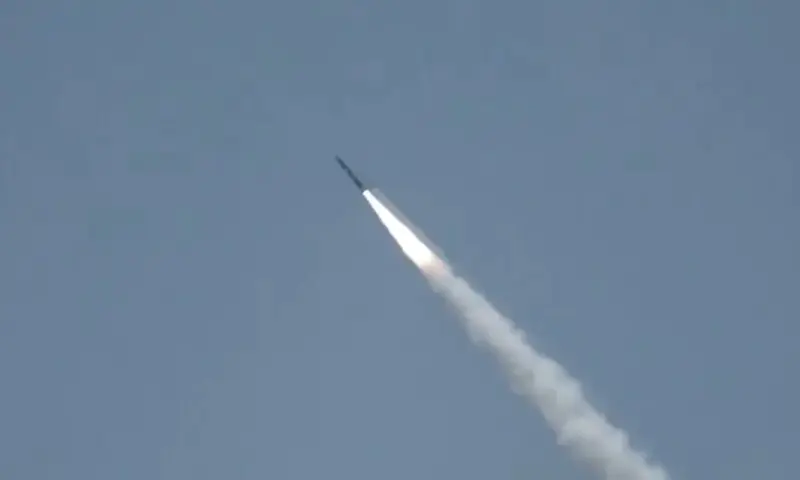
Pakistan has successfully conducted a training launch of its indigenously developed Fateh-II guided rocket system — and in the current regional security environment, with tensions running at some of their highest levels in recent memory, the timing of this test is as significant as the test itself. This was not a routine exercise buried quietly in a defence ministry press release. It was a deliberate demonstration of capability, conducted in the full view of the international community, with senior military officials and national leadership both present and both publicly acknowledging what it represents.
The Fateh-II is not a new programme suddenly pulled out in response to recent events. It is the product of years of sustained work by Pakistan's defence scientists, engineers, and military planners — people who have been building toward exactly this kind of capability through the kind of patient, unglamorous technical development that does not make headlines until the moment it does. The successful training launch confirms that the work has reached the point of operational maturity — that this is not a prototype being tested in controlled laboratory conditions but a system being evaluated in the kind of exercise environment that reflects real military use.
For Pakistan's leadership, which has been navigating an extraordinarily complex security environment while simultaneously managing one of the most consequential diplomatic efforts in the country's history, the Fateh-II test sends a message that is clear without needing to be made explicit. Pakistan is watching. Pakistan is prepared. And Pakistan's ability to defend itself has been advancing quietly and consistently even while its diplomats have been carrying messages between Washington and Tehran.
What the Fateh-II Actually Is — Understanding the System
The Fateh-II is a guided multiple launch rocket system — a category of weapon that sits at the intersection of traditional artillery and precision-guided munitions in ways that give it capabilities that neither category alone fully possesses. Understanding what that means in practice helps explain why a successful test of this system is a militarily significant development rather than simply a headline.
Traditional artillery — howitzers, conventional rocket systems — fires projectiles that follow ballistic trajectories and land within a certain radius of their intended target. That radius, called the circular error probable, is acceptable for some kinds of targets but insufficient for others. When precision matters — when the target is a specific piece of infrastructure, a command facility, or a high-value military asset rather than a general area — traditional artillery's inherent inaccuracy becomes a serious limitation.
Guided rocket systems like the Fateh-II address this limitation by incorporating navigation and guidance technologies that actively steer the projectile toward its target throughout its flight rather than simply launching it in the right general direction and hoping ballistics do the rest. The advanced avionics and modern navigation features described in official statements about the Fateh-II — which almost certainly include some combination of inertial navigation, GPS guidance, and potentially terminal guidance technologies — are what allow the system to achieve the kind of accuracy that transforms it from a weapon that can hit a general area into a weapon that can hit a specific target.
The range capabilities of the Fateh series — Pakistan has developed both the Fateh-I and the more capable Fateh-II — give the system the ability to engage targets at distances that keep the launch platforms outside the range of many counter-battery systems, which significantly improves the survivability of the weapon crews. This combination of range, accuracy, and survivability is what makes modern guided rocket systems genuinely important military capabilities rather than incremental improvements on existing technology.
The "indigenously developed" description in official statements is worth paying attention to and taking seriously rather than treating as routine nationalist language. Defence indigenisation — the development of military systems through domestic engineering and manufacturing rather than through foreign procurement — is genuinely difficult and genuinely important. Countries that can design, build, and maintain their own advanced weapons systems are less vulnerable to supply disruptions, export control restrictions, and the kind of political leverage that weapons-dependent relationships create. Pakistan's ability to develop a system of the Fateh-II's sophistication domestically reflects a level of defence industrial capability that has been built over decades and that represents a genuinely strategic national asset.
Advanced Avionics and Navigation — What Makes the Fateh-II Different
The specific mention of advanced avionics and modern navigation features in the official description of the Fateh-II is not just technical boilerplate — it points to the capabilities that distinguish this system from its predecessors and from simpler rocket systems that lack these technologies.
Avionics, in the context of a guided weapon system, refers to the electronic systems that manage flight control, navigation, and guidance throughout the weapon's trajectory. In a system like the Fateh-II, these would include the sensors that determine the weapon's current position and velocity, the processing systems that calculate the guidance corrections needed to keep it on track to its target, and the control mechanisms that translate those corrections into physical adjustments to the weapon's flight path.
The sophistication of these systems determines the accuracy of the weapon — and accuracy is everything in precision-guided munitions. A weapon that can reliably land within a few metres of its intended target has fundamentally different military utility than one that lands within a few hundred metres. The former can be used against specific high-value targets with confidence that the target will be destroyed. The latter is useful primarily for area suppression rather than precision strikes.
The survivability dimension that official statements mention is equally important. A missile system that can be tracked and intercepted before reaching its target loses most of its military value regardless of its accuracy. Modern air defence systems are increasingly capable of engaging incoming rockets and missiles, and developing systems that can survive those defences — through speed, manoeuvrability, low radar cross-section, or other techniques — is a major focus of advanced weapons development globally. The Fateh-II's guidance capabilities likely contribute to its survivability by allowing it to fly non-standard trajectories that are harder for air defence systems to engage than simple ballistic paths.
The Training Exercise — What Was Actually Being Tested
The description of this launch as a training exercise rather than a development test is an important distinction that tells you something specific about where the Fateh-II programme currently stands. Development tests are about proving that a system works — that the engineering is sound, that the subsystems function as designed, and that the overall system meets its specifications. Training exercises are about something different — they are about ensuring that the military personnel who will actually operate the system in the field can do so effectively under conditions that reflect real operational use.
The fact that this was a training launch suggests that the Fateh-II has already passed through its development testing phases and has reached a level of maturity where the focus has shifted to integrating it into operational military units and ensuring that those units can use it effectively. That transition — from development programme to operational capability — is a genuinely significant milestone in any weapons system's lifecycle, and it is one that often gets less attention than the initial development announcements even though it is the point at which the system actually becomes a real military capability rather than a programme.
The testing of key subsystems during the exercise reflects the comprehensive nature of what a training launch involves. It is not just about whether the missile flies and lands where it should — it is about testing the full chain of capabilities that a real operational use would require. That includes the systems that identify and designate targets, the command and control infrastructure that coordinates the launch, the logistics and handling procedures for preparing and deploying the weapon in field conditions, and the training of every person in the operational chain who has a role in a real-world employment of the system.
Senior military officials, scientists, and engineers from strategic organisations were present during the launch — a combination that reflects the dual nature of what was being evaluated. The military officials were assessing operational readiness and the performance of the troops conducting the exercise. The scientists and engineers were reviewing technical performance data and assessing whether any refinements to the system are warranted based on what the exercise revealed. Both kinds of assessment are valuable and both contribute to the ongoing process of maintaining and improving the capability that the Fateh-II represents.
The Geopolitical Context — Why This Test Matters Right Now
Weapons tests do not happen in geopolitical vacuums, and anyone trying to understand the significance of the Fateh-II training launch needs to place it in the context of Pakistan's current security environment — because that context is what gives the timing of this exercise its particular resonance.
Pakistan is currently navigating one of the most elevated and multidimensional threat environments it has faced in recent years. Defence Minister Khawaja Asif issued a public warning earlier this year about the possibility of Indian strikes on Pakistani cities — a statement that reflected a genuine intelligence assessment rather than political posturing and that was accompanied by the placement of security forces on high alert across the country. Operation Ghazab lil Haq was launched and remains active in border areas. The bilateral relationship with India has been under significant strain, with the kind of tension that historically has occasionally escalated into military incidents despite both countries' shared interest in avoiding full-scale conflict.
Against that backdrop, a successful test of a precision-guided rocket system with the capabilities of the Fateh-II is a clear message. It says that Pakistan's conventional military capabilities are advancing, that its ability to conduct precise strikes at meaningful ranges is real and improving, and that any calculation about the military balance in the region needs to take that capability into account. This is deterrence communication in its most direct form — demonstrating capability to reduce the likelihood that adversaries will make decisions based on an underestimation of what Pakistan can do.
The nuclear dimension of Pakistan's deterrence posture is well understood and has been for decades. What the Fateh-II represents is a contribution to the conventional layer of that deterrence — the ability to respond to threats and conduct operations below the nuclear threshold with precision and effectiveness that denies adversaries the assumption that conventional military action against Pakistan can be conducted without serious consequences. Conventional deterrence and nuclear deterrence are not alternatives — they are complements, and strengthening one reinforces the overall deterrence posture in ways that matter for stability.
Indigenous Development — What It Means for Pakistan's Defence Industry
The emphasis on indigenous development in the Fateh-II programme is more than a point of national pride — it reflects a strategic choice about the kind of defence industrial base Pakistan wants to build and maintain, and the progress that this test represents on that journey deserves serious recognition.
Pakistan's defence industry has been developing steadily over the decades since independence, building from a base that initially involved primarily maintenance and limited production of foreign-designed systems toward an increasingly capable domestic development and manufacturing capability. Organisations like the National Engineering and Scientific Commission, the Space and Upper Atmosphere Research Commission, Pakistan Ordnance Factories, and the various research and development establishments under the strategic plans division have been the institutional backbone of this development — building the scientific and engineering workforce, the technical infrastructure, and the institutional knowledge that make systems like the Fateh-II possible.
The development of a precision-guided rocket system involves capabilities across multiple technical domains simultaneously — propulsion engineering, materials science, electronics and avionics design, software development, systems integration, and manufacturing quality control, among others. Each of these domains requires specialised expertise that takes years to develop, and the ability to bring all of them together in a working system of the Fateh-II's sophistication reflects a genuine maturity of Pakistan's defence engineering capacity.
The strategic value of that capacity goes beyond any individual system. Engineers and scientists who develop one precision-guided system have built knowledge and experience that transfers to the next development programme. Manufacturing facilities that produce one class of weapon can be adapted to produce the next. Quality control systems, testing protocols, and supply chain relationships developed for one programme reduce the cost and time required for subsequent ones. Indigenous defence development is a cumulative enterprise in which each programme builds on what came before, and the Fateh-II represents a significant addition to the foundation on which Pakistan's future defence development will build.
Leadership Recognition — What the Congratulations Signal
The congratulations extended to the scientists, engineers, and armed forces personnel by Pakistan's President and Prime Minister are more than ceremonial — they reflect a deliberate choice by national leadership to publicly recognise and validate the people and institutions responsible for Pakistan's defence development, and that recognition carries both symbolic and practical significance.
Symbolically, having the head of state and head of government personally acknowledge the achievement communicates to the defence scientific community that their work is seen, valued, and considered a priority at the highest level of national leadership. For people who often work in relative obscurity on technical challenges that do not produce the kind of public visibility that political or media careers do, that acknowledgment matters for morale and for institutional culture.
Practically, public recognition by national leadership is one of the signals that influences the career choices of young Pakistani scientists and engineers. When a missile test is celebrated at the level of a presidential congratulation, it communicates to talented young people that defence science and engineering is a field that the country values and that offers the kind of recognition and career significance that attracts ambitious and capable people. Defence development programmes are only as good as the people they can recruit and retain, and the culture of recognition that flows from moments like this influences that recruitment over time.
The specific praise for "dedication, technical skills, and commitment" is also worth noting. These are not generic compliments — they point to the specific qualities that defence development actually requires. Dedication because these programmes involve years of sustained effort on problems that do not always have obvious solutions. Technical skills because the engineering challenges involved are genuinely difficult and require real expertise. Commitment because the mission — contributing to Pakistan's ability to defend itself — requires a kind of sustained purpose that goes beyond the ordinary motivations of professional achievement.
Pakistan's Broader Defence Development Trajectory
The Fateh-II test is one visible marker in a broader trajectory of Pakistani defence development that has been advancing across multiple domains simultaneously and that reflects a consistent long-term commitment to building the capabilities that Pakistan's security situation requires.
Pakistan's nuclear programme, which achieved its most visible milestone in the 1998 tests at Chagai, has continued to develop and diversify since then — with the development of a range of delivery systems, the refinement of the strategic doctrine around those systems, and the building of the command and control infrastructure that makes a credible nuclear deterrent something more than just having weapons. The Nasr tactical ballistic missile, which was developed to address specific gaps in the spectrum of deterrence below the strategic nuclear level, reflects the sophistication of Pakistan's thinking about the full range of deterrence requirements.
Conventional military capabilities have been advancing in parallel — through the development of indigenous weapons systems like the Fateh series, through the JF-17 Thunder fighter aircraft programme developed jointly with China, through naval development including the Hangor-class submarine programme whose commissioning was attended by President Zardari during his China visit, and through investments in intelligence, surveillance, and reconnaissance capabilities that multiply the effectiveness of weapons systems by improving the quality of the information they act on.
Cyber and electronic warfare capabilities, while less visible in public statements, are another domain where Pakistan's defence establishment has been investing in recognition of how fundamentally modern warfare has evolved beyond the traditional domains of land, sea, and air. The integration of these capabilities into a coherent operational concept is one of the central challenges of contemporary military development, and Pakistan's defence planners are engaged with exactly these questions.
What the International Community Will Notice
Pakistan's Fateh-II training launch will be noted and assessed by governments and defence establishments around the world — and the assessments they make will inform their own planning and their understanding of the regional military balance in ways that have real implications for Pakistan's security environment going forward.
India, as Pakistan's principal strategic competitor in the regional context, will conduct its own detailed technical assessment of what the Fateh-II test reveals about Pakistan's precision strike capabilities and what it implies for the conventional military balance on the subcontinent. That assessment will feed into Indian defence planning and potentially into procurement decisions aimed at maintaining or improving India's own conventional capabilities relative to Pakistan's.
China, as Pakistan's most important defence partner, will note the test as confirmation of the effectiveness of the cooperation and technology transfer that has supported Pakistan's defence development and as validation of the strategic partnership that the relationship represents. Chinese defence establishments will also be monitoring the technical performance data that the exercise generates, as a contribution to their own understanding of how the systems they have collaborated on perform in the field.
Western governments and intelligence agencies will assess the test as a data point in their understanding of Pakistan's defence capabilities and their implications for regional stability. The precision-guided capabilities that the Fateh-II represents are a particular focus of interest because they change the conventional strike calculus in ways that have direct implications for crisis management and escalation dynamics in potential future conflicts.
Final Thoughts
Pakistan's successful training launch of the Fateh-II guided rocket system is a militarily significant development that deserves to be understood on its own terms rather than reduced to either a chest-thumping nationalist narrative or a destabilising provocation. It is neither of those things. It is a demonstration of real and advancing capability, developed through years of patient indigenous effort, tested in conditions that reflect operational reality, and timed in a context that gives it a deterrence communication dimension that is entirely appropriate given the security environment Pakistan is currently navigating.
The scientists and engineers who built this system, the military personnel who operate it, and the institutional infrastructure that supported its development all deserve the recognition that national leadership has extended to them. They have contributed something real and durable to Pakistan's ability to defend itself — a capability that will exist and continue to develop long after the specific current tensions that make its demonstration timely have resolved.
Pakistan's security, in the end, rests on a combination of diplomacy and deterrence — the ability to resolve disputes peacefully when that is possible, and the ability to defend itself effectively when it is not. The Fateh-II training launch is a contribution to the deterrence side of that equation. The diplomatic work being done simultaneously in Islamabad, Beijing, and through the Iran-US mediation process is the contribution to the other side. Both matter. Both are being pursued seriously. And both together constitute what a responsible approach to national security actually looks like in the complex environment that Pakistan currently inhabits.