
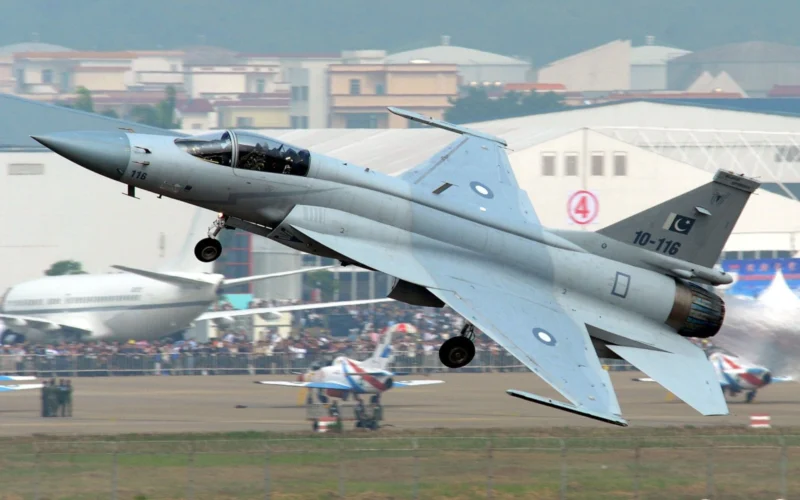
Pakistan's Air Power Gave China's Jet Industry Its Biggest Ever Year
The Battle That Rewrote the Global Arms Market — And Nobody Saw It Coming
In May 2025, something happened over the skies of South Asia that military analysts, defence industry executives, and arms procurement officials around the world are still processing the full implications of. When India launched its military operation against Pakistan, the global defence establishment expected to see Western-made equipment perform with the dominance that decades of marketing, NATO endorsements, and combat records in Middle Eastern conflicts had led most buyers to assume was simply the natural order of things.
What they saw instead was Pakistan's Air Force — equipped primarily with Chinese-made J-10C fighter jets and PL-15 beyond-visual-range missiles — shoot down seven Indian aircraft over the course of an 87-hour conflict. Among the downed aircraft was the Rafale — France's most advanced fourth-generation fighter jet, a platform that had been sold to India, Egypt, Greece, and Qatar partly on the basis of its supposed technological edge and combat capability. Seeing a Rafale fall to a Chinese-made missile fired from a Chinese-made jet was not a scenario that French defence exports marketing had prepared the world for.
The US-brokered ceasefire on May 10 ended the shooting. But the reverberations of what those 87 hours revealed about the actual performance of Chinese military technology in real combat conditions against real Western equipment are still moving through global defence markets in ways that are now showing up in corporate revenue figures, procurement decisions, and the strategic calculations of governments from Southeast Asia to the Middle East and beyond.
Chengdu's Historic Numbers — What the Financials Are Really Saying
China's AVIC Chengdu Aircraft Corporation — the manufacturer of the J-10C fighter jet — released its 2025 financial results, and the numbers tell a story that no press release could fully convey. Revenue rose 15.8 percent to 75.4 billion yuan — approximately eleven billion US dollars. Profit climbed 6.5 percent to 3.4 billion yuan. According to Bloomberg's analysis of the figures, both numbers represent the highest annual results in the company's entire history. Record revenue. Record profit. In the same year that its main export product performed in combat against Western equipment and won.
The causal connection is not being claimed explicitly by Chengdu — defence companies do not typically discuss specific conflicts in their financial communications — but it is being drawn by every analyst who has looked at the numbers in context. A 15.8 percent revenue jump in a single year, establishing all-time records, in the year after the J-10C's combat debut against a Rafale, is not a coincidence that requires elaborate explanation.
But the most striking number is not the annual figure. It is what happened in the first quarter of 2026. In just three months — January, February, and March — Chengdu's sales jumped by nearly 80 percent compared to the same period in the previous year. Eighty percent growth in a single quarter from a company that was already having its best year on record. That is not organic market growth. That is the defence procurement equivalent of a product going viral — the moment the world's purchasing officials, sitting in defence ministries from Jakarta to Baghdad to Dhaka, processed what had happened in May 2025 and started making phone calls.
Procurement cycles in the defence industry are typically slow, bureaucratic, and measured in years rather than months. The fact that the first quarter 2026 figures are already reflecting this kind of growth suggests that a significant number of countries moved very quickly indeed after the May 2025 conflict — accelerating conversations that may have been ongoing, unlocking budget approvals that had been stalled, and in some cases initiating entirely new procurement processes that simply did not exist before the combat results became public.
What Pakistan Actually Used — The Full Picture of Chinese Technology in Combat
The May 2025 conflict was not a showcase for a single Chinese system. It was a comprehensive field test of multiple Chinese military platforms operating together in real combat conditions against a well-equipped adversary — and the results across multiple systems were, by every account that has emerged since, significantly better than most Western analysts had publicly projected they would be.
The J-10C is a single-engine multi-role fighter that China's aviation industry developed over two decades through a combination of domestic engineering and, in its earlier iterations, significant Russian influence on engine technology. The version Pakistan flies — the J-10CE, the export variant — incorporates the WS-10B turbofan engine that represents a significant advancement in Chinese jet engine capability, an area where China's aerospace industry was long considered to lag behind Western and Russian competitors. The May 2025 conflict provided the first real combat test of what the mature J-10C platform can do in beyond-visual-range air combat, and the results were not what the Rafale's operators expected.
The PL-15 beyond-visual-range missile that the J-10C used to engage Indian aircraft is in many respects the more significant technology story of the conflict. Beyond-visual-range missile capability — the ability to engage and destroy enemy aircraft before either pilot can see the other — has been the decisive factor in air combat for decades, and the PL-15's performance in actual combat against real targets operating real electronic warfare and countermeasure systems gave the world its first genuine data point on how this missile performs outside of test ranges and simulations. The data point was evidently compelling enough to drive 80 percent first-quarter sales growth.
The HQ-9 air defence system — China's long-range surface-to-air missile system that forms Pakistan's strategic air defence backbone — also performed in its intended role during the conflict, protecting Pakistani airspace from Indian air operations in ways that demonstrated its effectiveness against real-world threats rather than just test conditions. This matters for global procurement because surface-to-air missile systems are among the highest-value and most strategically sensitive items in any country's defence budget, and demonstrated effectiveness against real threats is the ultimate test that procurement officials care about.
And then there is what the JF-17 Thunder allegedly accomplished. The jointly developed Pakistan-China fighter, which has been the workhorse of the Pakistan Air Force for over a decade, is reported to have destroyed India's S-400 air defence system at Adampur using hypersonic missiles — a claim that, if substantiated by independent analysis, would represent one of the most significant tactical achievements of the entire conflict. The S-400 is Russia's most advanced surface-to-air missile system and has been sold to India, China, Turkey, and others as near-invulnerable to conventional attack. A JF-17 destroying an S-400 with a hypersonic missile would be precisely the kind of combat result that rewrites procurement assumptions globally.
The Official Endorsement That Money Cannot Buy
In the arms industry, there is marketing and then there is battlefield validation. The two are not in the same category. No amount of advertising, no air show demonstration, no simulation result, no endorsement from a friendly government carries the weight of actual combat performance against a real adversary using real countermeasures in real operational conditions. The arms industry understands this better than any other sector, which is why combat records — or their absence — matter so profoundly to procurement decisions.
ISPR Director General Lieutenant General Ahmed Sharif Chaudhry understood exactly what his words would mean when he gave his October 2025 interview assessment of the Chinese equipment Pakistan had used. When he said that "recent Chinese platforms have demonstrated exceptionally well," he was not making a diplomatic courtesy comment about a friendly supplier. He was making a professional military judgment from the perspective of a force that had just used these systems in combat — a judgment delivered by an official of a country that had every incentive to be honest about performance because its own national security depends on accurate assessment of its equipment.
That endorsement, from a Pakistani military official speaking from post-combat experience, carried a quality of credibility that Chinese defence manufacturers cannot manufacture through any other means. It was worth more to Chengdu's marketing position than any number of trade show appearances or brochure specifications, because it addressed the one question that every potential buyer most wants answered — does this actually work when real lives and real national security depend on it?
The answer Pakistan provided, through its combat record and through its official assessment of that record, was unambiguous. And the first-quarter 2026 sales figures tell you how the market responded to that answer.
The Countries Now Looking at Chinese Jets — A New Procurement Map
The procurement interest generated by the May 2025 conflict has not been evenly distributed — it has followed a predictable logic that reflects which countries were already considering Chinese military equipment, which were operating Western equipment and now questioning their assumptions, and which were simply watching closely to see how the combat results would affect their own strategic calculations.
Indonesia has signaled specific interest in acquiring the J-10C — a significant development for the world's fourth most populous country, a major Southeast Asian economy, and a nation that has historically balanced its defence procurement between multiple suppliers as a deliberate strategy for maintaining strategic autonomy. An Indonesian decision to acquire J-10Cs would be a major commercial win for Chengdu and a significant geopolitical signal about the shifting balance of perception regarding Chinese versus Western military technology.
Iraq's interest in the JF-17 Thunder reflects a different kind of procurement logic. Iraq has been trying to rebuild a functional air force for over a decade in a context where American political conditions on weapons sales, budget constraints, and the legacy of multiple conflicts have complicated its procurement options. The JF-17's relatively lower cost compared to Western fighters, combined with its now-proven combat record, makes it an attractive option for a country that needs capable aircraft without the political strings that often accompany American or European sales.
Bangladesh's interest in the JF-17 fits a similar pattern — a country with real defence needs, limited defence budgets, and the pragmatic calculation that a proven and affordable platform beats an unproven but prestigious one. Bangladesh's consideration of the JF-17 is also geopolitically significant given its position in South Asia, where the choices its neighbours make about their defence procurement create pressure and precedent that shapes regional security dynamics.
Beyond the publicly named countries, there is a broader wave of interest that has not yet crystallised into formal procurement discussions but that is visible in the increased traffic of defence delegations visiting China, the increased frequency of queries being directed at Chinese defence export officials, and the accelerated timelines for procurement decisions that had been proceeding at a more leisurely pace before May 2025 gave everyone a reason to reconsider their assumptions.
The US Congress Report — When the Adversary Acknowledges the Result
In the hierarchy of evidence about military technology performance, there is perhaps no more compelling source than the adversary's own official acknowledgment that things did not go as expected. When a report presented to the United States Congress — the world's most powerful legislative body, responsible for overseeing the most expensive military establishment in history — formally acknowledged Pakistan's military success over India in the May conflict and specifically pointed to the advanced Chinese weaponry as a key factor, it was a moment of institutional candour that no amount of Chinese marketing could have manufactured.
American Congress members and the analysts who brief them are not motivated to flatter Chinese defence exports. The geopolitical context runs exactly in the opposite direction — the US has strong political and strategic incentives to minimise and dismiss evidence of Chinese military capability matching or exceeding Western technology. When the assessment apparatus that serves the US Congress produces an official report acknowledging that Chinese weapons outperformed Western ones in a real conflict, it is because the evidence is compelling enough that intellectual honesty overrides the political preference for a more comfortable conclusion.
The November 2025 report's acknowledgment of Chinese weapons performance was noted across the global defence community with the significance it deserved. If the United States Congress is acknowledging it, no other government's defence ministry can maintain a comfortable official position that the May 2025 results were anomalous, that the Western equipment would have performed differently in other circumstances, or that the Chinese systems got lucky. The congressional acknowledgment put an authoritative stamp on what the combat results themselves had already demonstrated.
For Chengdu's sales pipeline, the US Congress report was possibly the single most valuable piece of external validation that any defence manufacturer could receive — not because Chinese officials would cite it in their marketing, but because every defence ministry official making procurement decisions around the world read it and drew their own conclusions about what it meant for their own procurement choices.
What This Means for Western Defence Exports — The Other Side of the Story
The Chengdu revenue record is one side of a story whose other side involves some uncomfortable reassessments in Western defence export markets. The Rafale's performance in May 2025 — or more specifically, its vulnerability to Chinese-made missiles in the hands of Pakistani pilots — has created questions in procurement discussions that French defence officials are having to address with existing and prospective customers.
Dassault Aviation, the French company that builds the Rafale, has not responded publicly to the specific combat results in any detail — the classified nature of much of what happened, and the diplomatic sensitivity of France's relationship with India as a major Rafale customer, make detailed public engagement with the combat results complicated. But the conversations happening in procurement offices in countries that have bought or are considering buying the Rafale are not similarly constrained, and the questions being asked about the platform's vulnerability to PL-15 class missiles are real and persistent.
The broader American defence export market — F-16s, F-35s, and the full range of platforms that represent the dominant position Western manufacturers have held in global defence sales for decades — is also being watched with different eyes after May 2025. The F-35 remains in a different performance category than anything China currently exports, and its stealth and electronic warfare capabilities are not directly comparable to the combat scenarios that played out in May 2025. But the demonstrated ability of Chinese systems to engage and destroy French fourth-generation fighters at beyond-visual-range distances raises questions about the assumptions that underpin the export market for the F-16 and similar platforms.
None of this is to say that Western defence exports are facing a sudden collapse — the relationships, the interoperability with NATO systems, the training and logistics support infrastructure, and the political dimensions of arms sales all continue to favour Western suppliers for many customers. But the competitive landscape has shifted, and the manufacturers and governments that manage Western defence exports know it.
Pakistan's Strategic Validation — The Partnership That Goes Both Ways
For Pakistan, the May 2025 conflict produced something that goes considerably beyond a military victory or a ceasefire — it produced a strategic validation of the approach to defence procurement and partnership that Pakistan has been building for decades through its relationship with China.
The decision to develop the JF-17 jointly with China, to acquire the J-10C for the high-end air superiority role, and to build Pakistan's air defence around the HQ-9 system was not universally popular in Pakistani defence circles at the time those decisions were made. There were always voices arguing for Western equipment — for the political relationships, the technology prestige, and the assumed quality that Western procurement was supposed to deliver. The May 2025 results answered those debates more definitively than any procurement review or policy paper could have.
But the strategic dimension runs deeper than just validating specific equipment choices. Pakistan's combat use of Chinese systems transformed China's defence export position in ways that create real and lasting value for the bilateral partnership. Before May 2025, Chinese military exports were purchased primarily by countries that lacked access to Western equipment or that were constrained by budget limitations from acquiring more prestigious Western platforms. After May 2025, Chinese military exports are being considered by countries that have full access to Western equipment but are now genuinely questioning whether Western technology automatically delivers superior capability at the relevant price points.
That transformation in how the world perceives Chinese defence exports happened because Pakistan flew Chinese jets in combat and demonstrated results. Pakistan did not simply benefit from the China partnership — it contributed to it in a way that has generated value for China that cannot be measured simply in military terms. The historic Chengdu revenue figures are partly a product of Pakistani pilots and Pakistani military decisions, and that creates a reciprocity in the relationship that both sides understand clearly.
The Long-Term Implications for Global Defence Markets
The reverberations of May 2025 are still working their way through global defence procurement in ways that will not be fully visible for several years — because defence procurement cycles are long and the decisions being influenced right now will not always appear as signed contracts or delivered equipment until 2027, 2028, or later.
But the direction of the shift is clear enough to describe with some confidence. The comfortable assumption that Western technology automatically delivers superior combat capability is no longer an assumption that can be made without reference to the May 2025 evidence. Chinese defence exports have a combat record that they simply did not have before, and that record changes the procurement calculus for every government that was on the fence about Chinese versus Western equipment.
The countries most likely to accelerate toward Chinese platforms are those that were already leaning in that direction for cost, political, or strategic autonomy reasons and simply needed a confidence-building data point to move their procurement processes forward. Countries in South and Southeast Asia, the Middle East, and Africa that are navigating relationships with both China and the West in their defence procurement are the natural first movers in this shift.
The countries least likely to change their behaviour are those deeply embedded in Western alliance structures — NATO members, close American allies with deep interoperability requirements — for whom the political and logistical dimensions of the procurement relationship outweigh the new data about Chinese combat performance. For them, May 2025 is a data point to be explained and contextualised rather than a reason to fundamentally reconsider their procurement direction.
But the countries in between — the large and significant middle ground of nations making genuinely independent procurement decisions based on their own strategic assessments — are where May 2025 has had and will continue to have the most significant impact. And it is in that middle ground where the first-quarter 2026 sales figures are being generated and where Chengdu's historic revenue numbers are finding their explanation.
Final Thoughts
The story that Chengdu Aircraft Corporation's 2025 financial results tell is ultimately not a story about corporate revenue or defence industry market share — it is a story about how military technology is validated, how global perceptions shift when validation happens in real combat rather than on paper, and how a single conflict can fundamentally reshape the assumptions that govern one of the world's most consequential markets.
Pakistan's Air Force went into the May 2025 conflict as an operator of Chinese military equipment that most Western analysts had assessed as probably capable but unproven against first-rate adversaries. It came out of the conflict with a combat record that answered the unproven question definitively, in the most direct possible way, against equipment that the global defence market had consistently rated highly.
The result is record revenues for Chengdu, 80 percent first-quarter growth, growing procurement interest from Indonesia to Iraq to Bangladesh, a US Congress report acknowledging Chinese weapons performance, and a fundamental shift in the competitive landscape of global defence exports that will be working its way through procurement decisions for years to come.
And at the centre of all of it — Pakistan's Air Force, flying Chinese jets, proving a point that no simulation, no air show, and no specification document could have proven as convincingly as those 87 hours in May 2025 did.