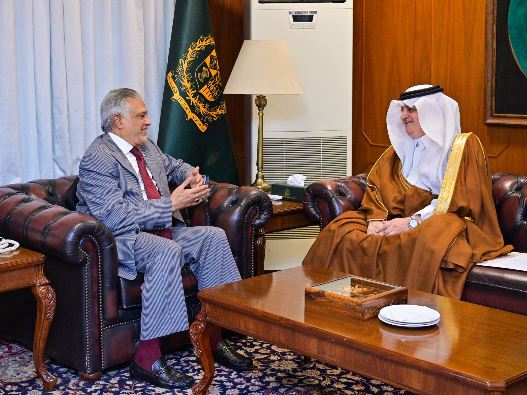
Saudi Ambassador Meets Ishaq Dar, Discusses Regional Peace
Saudi Ambassador Meets Ishaq Dar — A Meeting That Carries More Weight Than Usual
When the Ambassador of the Kingdom of Saudi Arabia to Pakistan, H.E. Nawaf bin Saeed Ahmad Al-Malkiy, sat down with Deputy Prime Minister and Foreign Minister Senator Mohammad Ishaq Dar for what official statements describe as an important meeting, the diplomatic language around the encounter — regional developments, peace and stability, bilateral cooperation — is the kind of carefully chosen phrasing that signals significance without spelling it out directly.
In normal times, a meeting between a foreign ambassador and a host country's foreign minister is routine diplomatic maintenance — the kind of regular contact that keeps bilateral relationships functioning smoothly and that ensures both sides are informed about each other's positions on matters of shared concern. In the current regional environment, however, nothing about this meeting is routine. Pakistan is at the centre of one of the most consequential diplomatic processes happening anywhere in the world right now, Saudi Arabia has its own enormous and direct stakes in the Iran-US conflict and its resolution, and a meeting between Riyadh's ambassador and Pakistan's chief diplomat at this particular moment carries implications that extend well beyond the standard bilateral agenda.
The timing tells you something. The content of what was discussed — as much as official readouts reveal — tells you more. And the combination of what was said publicly and what was almost certainly discussed in more specific terms privately gives a picture of two countries with deep, long-standing ties navigating a moment when the regional situation is demanding real and urgent diplomatic engagement rather than the kind of maintenance conversations that fill most of the calendar in quieter times.
Who Is the Saudi Ambassador and Why This Meeting Matters
H.E. Nawaf bin Saeed Ahmad Al-Malkiy represents the Kingdom of Saudi Arabia in Islamabad at a moment when Saudi Arabia's own diplomatic positioning in the broader regional situation is one of the most closely watched dimensions of Middle Eastern geopolitics. As ambassador, he carries not just the routine bilateral portfolio but the weight of a relationship between two countries that is built on decades of deep connection across religious, economic, people-to-people, and strategic dimensions.
Saudi Arabia and Pakistan share a relationship that is unusual in its depth and its breadth. The religious connection — both countries' majority Muslim populations, the significance of the Holy Cities of Mecca and Medina to Pakistani Muslims, and the annual pilgrimage that brings hundreds of thousands of Pakistanis to Saudi Arabia every year — creates a bond that goes beyond the political and economic calculations that typically define bilateral relationships. It is a connection that exists in the lived experience of ordinary Pakistanis in a way that most bilateral relationships simply do not.
The economic dimension is equally significant. Saudi Arabia is host to one of the largest Pakistani diaspora communities in the world — millions of Pakistani workers and professionals whose remittances represent a critical component of Pakistan's foreign exchange earnings and whose welfare is a direct responsibility of the Pakistani state through its consular missions in the Kingdom. Any development that affects the Pakistani community in Saudi Arabia has immediate and direct implications for Pakistani households at home, creating a level of economic interdependence that gives the bilateral relationship a practical urgency beyond its political symbolism.
Saudi Arabia has also been a significant source of financial support for Pakistan during periods of economic crisis — providing deposits in the State Bank of Pakistan, extending deferred payment facilities for oil imports, and contributing to the international financial support packages that have helped Pakistan manage balance of payments pressures on multiple occasions. That financial relationship creates obligations of gratitude and consultation that Pakistani diplomacy takes seriously and that shapes the kind of engagement Ishaq Dar would bring to a meeting with Riyadh's ambassador.
The Regional Situation — What Both Sides Are Really Discussing
The official description of the meeting as focusing on "recent developments in the region and ongoing diplomatic efforts" is accurate but deliberately imprecise — because the specific regional developments that both sides are most focused on are ones that require careful handling in public statements even as they dominate the private conversation.
The Iran-US conflict and Pakistan's mediation role in trying to bring both sides toward a negotiated outcome is the central regional development that shapes everything else in the current diplomatic landscape. Saudi Arabia, as a major Sunni Arab power with a long and complicated relationship with Shia Iran, has its own very direct stake in how the Iran-US conflict resolves — and that stake is not perfectly aligned with any other party's interests, including Pakistan's.
Saudi Arabia and Iran have been regional rivals for decades, competing for influence across the Arab and Muslim world and supporting opposing sides in multiple regional conflicts. The relationship reached a severe low point in 2016 when Saudi Arabia executed a prominent Shia cleric and Iranian protesters stormed Saudi diplomatic missions in Tehran, leading to the severance of diplomatic relations. A Chinese-brokered normalisation agreement in 2023 restored those relations, but the underlying tensions and competing interests have not disappeared — they have simply been managed more carefully.
A resolution of the Iran-US conflict that significantly strengthens Iran's regional position — lifting sanctions, ending the blockade, potentially allowing Tehran to rebuild its economic and military capabilities — is not straightforwardly welcome in Riyadh. Saudi Arabia's calculation about such an outcome involves weighing the benefits of regional de-escalation against the concern that a revitalised Iran could become a more assertive competitor for regional influence. That calculation is complex and is being worked through in real time as the diplomatic process unfolds.
Pakistan's role as a mediator puts it in the middle of exactly these competing regional calculations. Islamabad has relationships with both Iran and Saudi Arabia that it needs to maintain and balance — and those relationships occasionally pull in different directions. The Saudi ambassador's meeting with Ishaq Dar is partly about ensuring that Saudi Arabia is informed about Pakistan's mediation activities and understands Pakistan's approach, and partly about Saudi Arabia communicating its own perspectives and concerns to Islamabad at a moment when Pakistan's actions have direct relevance to Saudi interests.
What Ishaq Dar Emphasised — Reading the Message
Dar's emphasis during the meeting on the importance of dialogue and engagement between all parties, and his insistence that peaceful solutions are necessary for long-term regional security, are not generic diplomatic talking points in this context. They are a specific and deliberate communication of Pakistan's position on how the current regional tensions should be addressed — and they are a position that is being communicated not just to Saudi Arabia but through this meeting to the broader audience of regional and international actors who follow these diplomatic exchanges.
The emphasis on "all parties" is particularly significant. In a regional situation with multiple actors holding stakes and interests — the United States, Iran, Saudi Arabia, the Gulf states, Israel, Pakistan, Russia, China, and others — the insistence that dialogue must involve all relevant parties rather than being managed through a narrow bilateral framework reflects a sophisticated understanding of what makes regional security arrangements durable. Agreements that exclude significant stakeholders tend not to hold, and Pakistan's mediation experience gives its foreign minister credibility when he makes this argument.
The assertion that peaceful solutions are necessary for long-term regional security is also more specific than it sounds. It is a direct statement that military options — however tempting they might appear from certain perspectives as a way of resolving specific immediate problems — create consequences that undermine regional stability in ways that make everyone worse off over time. Pakistan, sitting at the intersection of South Asia and the Middle East and dealing with the economic consequences of regional instability in the form of elevated fuel prices and disrupted trade routes, has direct and personal experience of what regional conflicts cost even for countries that are not direct parties to them.
Dar's expression of gratitude for Saudi Arabia's continued support, and his acknowledgment of the Kingdom's role in promoting stability, are the reciprocal elements of a conversation between two parties who need each other's engagement and who understand that maintaining warm relations requires consistent acknowledgment of what each side contributes. Saudi Arabia's financial support for Pakistan has been significant and consequential, and recognising it publicly in the context of a diplomatic meeting is not just politeness — it is an accurate statement of a real economic relationship that Pakistan values and depends on.
Saudi Arabia's Stake in Pakistan's Mediation Role
One of the dimensions of this meeting that official statements touch on only obliquely is Saudi Arabia's specific interest in how Pakistan's Iran mediation proceeds and what outcomes it might produce. That interest is real, significant, and worth examining directly.
Saudi Arabia has its own longstanding back-channel relationships with both the United States and Iran, and its own diplomatic capacity to engage with the conflict resolution process. But it has not been at the centre of the current round of mediation — that role has gone to Pakistan, with Oman playing a parallel back-channel function. Understanding why Pakistan rather than Saudi Arabia occupies the central mediation role is important for understanding the regional diplomatic architecture.
Pakistan's credibility with both Washington and Tehran rests partly on its absence of the kind of deep sectarian and geopolitical rivalry with Iran that Saudi Arabia carries. Saudi Arabia, as a Sunni Arab monarchy with a history of direct conflict with Iran's regional ambitions, cannot credibly present itself as a neutral facilitator between Tehran and Washington in the way that Pakistan — which has religious and cultural connections with Iran without the history of direct geopolitical rivalry — can. The trust that Iran has placed in Pakistan as a mediator is precisely because Pakistan does not carry the weight of Saudi-Iranian tensions.
This means that Saudi Arabia's influence on the Iran-US diplomatic process runs partly through its relationship with Pakistan. By engaging closely with Islamabad, communicating its perspectives and concerns, and maintaining its own bilateral dialogue with both Washington and Tehran separately, Saudi Arabia participates in shaping the regional situation even without occupying the central mediator role. The meeting between Dar and the Saudi ambassador is one moment in that ongoing engagement — Saudi Arabia ensuring that its voice is heard in Islamabad's calculations even as Pakistan does the specific work of bringing Washington and Tehran together.
The Pakistan-Saudi Economic Relationship — More Than Just Remittances
The economic dimensions of the Pakistan-Saudi relationship deserve more than a passing mention, because they are one of the most concrete and consequential aspects of a bilateral partnership that is often discussed primarily in terms of religious and political solidarity.
Pakistani workers in Saudi Arabia represent one of the country's most important sources of foreign exchange remittances. Millions of Pakistanis are employed across the Saudi economy — in construction, in manufacturing, in retail, in healthcare, in domestic services, and in a wide range of other sectors. The money they send home is a lifeline for the families who depend on it and a significant contributor to Pakistan's overall remittance inflows, which are one of the most important components of the country's foreign exchange earnings.
The welfare of those workers — their employment conditions, their legal protections, their access to Pakistani consular assistance when they need it, and their ability to earn and remit the money that their families depend on — is therefore a direct domestic economic concern for Pakistan, not just a consular service matter. Any development that affects employment conditions for Pakistani workers in Saudi Arabia, or that changes the regulatory environment for migrant workers in the Kingdom, has immediate and measurable consequences for Pakistani households.
Saudi Arabia's periodic oil support for Pakistan — through deferred payment arrangements that allow Pakistan to import Saudi oil without immediate cash payment — has been a significant form of economic assistance during periods of balance of payments pressure. In the current environment, with global oil prices elevated because of the regional conflict, the terms on which Pakistan accesses Saudi oil supplies matter significantly for the country's economic management.
Saudi investment in Pakistan has been a recurring topic of bilateral discussions for years. The potential for Saudi sovereign wealth and private investment to contribute to Pakistani economic development — in agriculture, in energy, in real estate, and in other sectors — is real and has been discussed at various levels without always translating into the level of concrete investment that both sides have aspired to. Whether the current meeting included any advancement of specific investment discussions is not clear from official statements, but it would be surprising if it did not at least touch on the investment relationship given the economic agenda that typically features in senior bilateral engagements.
Religious and People-to-People Ties — The Foundation of the Relationship
The "fraternal relationship" language that appears in the official description of both sides' characterisation of Pakistan-Saudi ties is not diplomatic boilerplate in the way that it might be for other bilateral relationships. It reflects something real about the depth of the connection between the two countries that goes beyond the political and economic dimensions and that is felt by ordinary people in ways that most bilateral relationships are not.
Hajj — the annual Muslim pilgrimage to Mecca — is one of the most significant religious obligations in Islam and one of the most practically important dimensions of the Pakistan-Saudi relationship from the perspective of ordinary Pakistani Muslims. Hundreds of thousands of Pakistanis perform Hajj every year, and the management of Pakistani pilgrims — their visa allocations, their accommodation, their safety, and their spiritual experience — is a direct responsibility that both governments take seriously. The annual Hajj season is itself a major bilateral coordination exercise that requires close cooperation at every level from the senior diplomatic to the practical consular.
The Umrah pilgrimage, which can be performed throughout the year rather than only during the specific Hajj season, brings millions more Pakistani Muslims to Saudi Arabia annually. The communities of Pakistani workers permanently based in the Kingdom maintain mosques, cultural associations, and social networks that connect the Pakistani diaspora in Saudi Arabia to their homeland in ways that are living expressions of the people-to-people relationship that official statements invoke.
This depth of human connection gives the Pakistan-Saudi relationship a resilience and a warmth that purely strategic relationships rarely possess. When diplomatic or political difficulties arise — as they occasionally do in any bilateral relationship — the underlying foundation of religious and cultural connection provides a basis for working through the difficulties that more transactional relationships lack. Both sides understand this and both sides value it, which is part of why meetings like the one between Dar and the Saudi ambassador consistently emphasise the fraternal character of the relationship alongside the political and economic agenda.
The Coordination on Regional Matters — What Both Sides Need From Each Other
The commitment both sides expressed to "continuing close coordination on regional matters" is the most forward-looking element of the official readout from the meeting, and it is worth thinking carefully about what that coordination actually involves and why both countries consider it important.
Pakistan needs Saudi Arabia's understanding and support for its mediation role in the Iran-US conflict. If Saudi Arabia were to actively work against the Pakistan-mediated process — by encouraging Iran to take harder positions, by lobbying Washington to pursue different channels, or simply by publicly expressing skepticism about Pakistan's approach — it would create complications for a mediation effort that already faces enough challenges from the positions of the primary parties. Saudi Arabia's supportive posture, or at minimum its non-interference, is a genuine contribution to the possibility of a successful outcome.
Saudi Arabia needs Pakistan's insight into the state of the Iran-US diplomatic process and Pakistan's perspective on Iranian intentions and flexibility. Pakistan's direct engagement with Iranian officials at the highest level — Field Marshal Munir's personal visits to Tehran, Dar's regular phone calls with Araghchi, the proximity talks in Islamabad — gives Pakistani officials a quality of real-time understanding of where Tehran's thinking actually is that Saudi Arabia's own intelligence and diplomatic channels, while significant, may not fully replicate. Riyadh values that insight and will want to ensure it has access to Pakistan's reading of the situation as it develops.
On the broader regional agenda — Yemen, Lebanon, Iraq, Syria, and the other conflict situations and political dynamics that shape the Middle Eastern security environment — both countries have interests that overlap significantly even if they do not perfectly align. Regular coordination ensures that neither side is caught off guard by the other's positions, that shared concerns are addressed collectively where possible, and that the relationship has the substance of regular consultation rather than the hollow form of diplomatic meetings that produce only warm statements.
Final Thoughts
The meeting between Saudi Ambassador H.E. Nawaf bin Saeed Ahmad Al-Malkiy and Foreign Minister Ishaq Dar is a significant diplomatic engagement that reflects the depth and the current relevance of the Pakistan-Saudi relationship at a moment when both countries are navigating a complex and consequential regional situation.
Saudi Arabia's stake in how the Iran-US conflict resolves, Pakistan's central role in mediating that conflict, and the deep bilateral ties that connect the two countries across religious, economic, and strategic dimensions all come together in a meeting like this one in ways that give it more substance and more significance than the official language of bilateral consultations typically conveys.
Both countries need the relationship to function well right now — Pakistan because Saudi Arabia's financial support, its influence in the region, and its understanding of the mediation process all matter for how Pakistan manages the extraordinary diplomatic challenge it has taken on, and Saudi Arabia because Pakistan's access to both Washington and Tehran, and its real-time understanding of where the diplomatic process stands, give Islamabad a perspective on regional developments that Riyadh genuinely values.
The fraternal language both sides use about their relationship is not empty. It reflects a genuine and deep connection that has survived decades of regional turbulence and that provides the foundation for exactly the kind of frank, substantive, and mutually supportive engagement that a meeting of this kind represents. In a region and a moment where trust between states is in short supply, that foundation matters more than it usually gets credit for.