
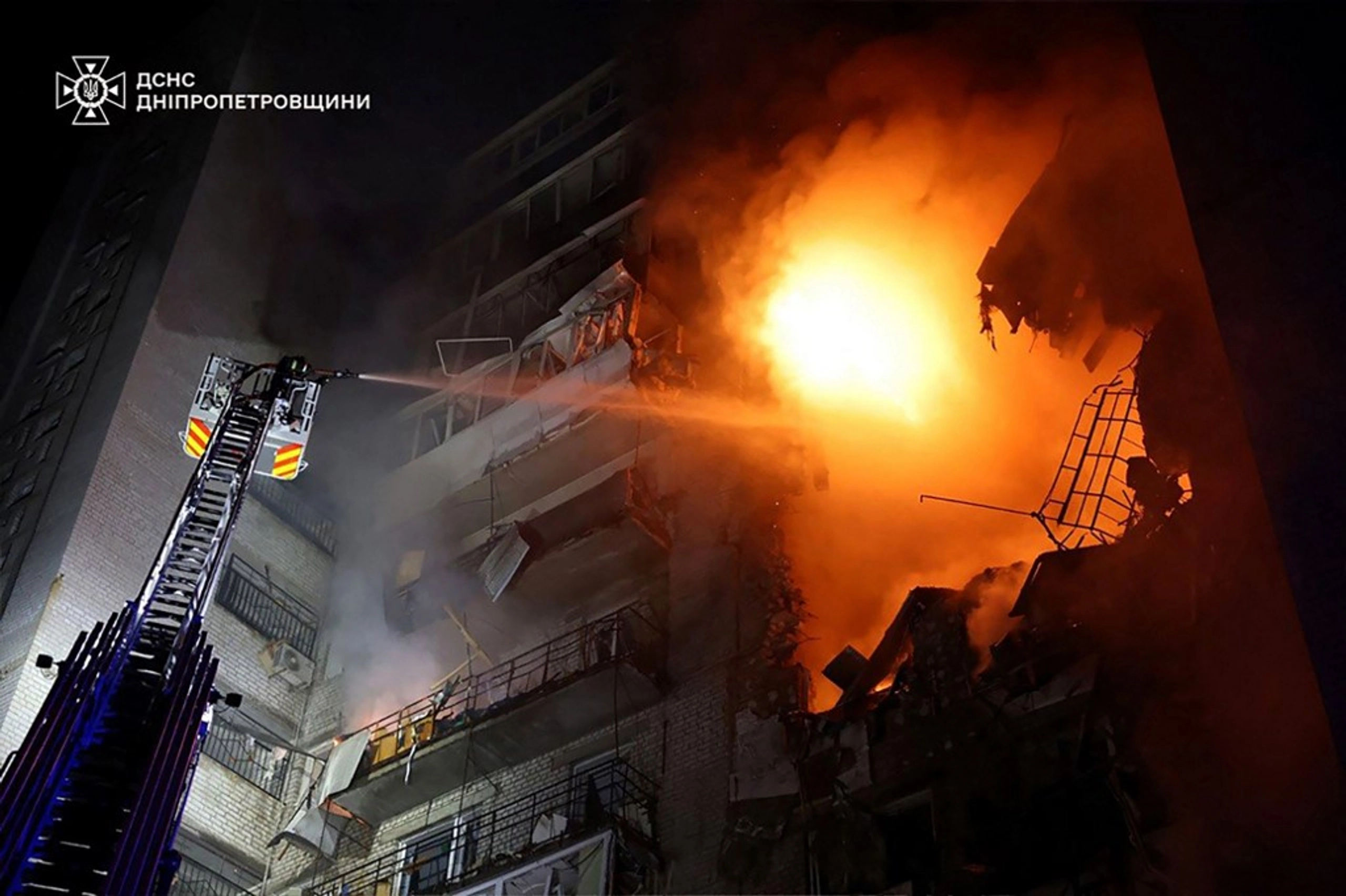
Russia Launches Large-Scale Drone and Missile Attack on Ukraine
Russia Launches Large-Scale Drone and Missile Attack on Ukraine — Multiple Cities Under Fire
The alerts started going off across Ukraine in the early hours, and this time the scale of what followed was not a localised strike or a targeted hit on a single piece of infrastructure. According to emerging reports, Russia has launched a large-scale coordinated attack using drones and missiles simultaneously across multiple regions of the country — the kind of broad, multi-vector assault that Ukrainian authorities and civilian populations have learned to fear most because of how difficult it is to fully intercept and how wide the potential damage can spread.
Loud explosions were reported in several cities as the attack began. Air raid sirens activated across multiple regions, sending the now-familiar warning to millions of Ukrainians to move to shelters, basements, and designated safe locations immediately. For people living in Ukraine's major cities and in areas closer to the front, that warning has become a regular and terrifying part of daily life — but the scale of tonight's attack, based on early reports, appears to be above the already elevated baseline that this war has established as normal.
Emergency services were placed on high alert the moment the attack signatures became clear. Ukrainian air defense systems activated quickly and interception operations began almost immediately. Some incoming drones and missiles have been reported intercepted, but the full picture of what got through, what was stopped, and what damage has been caused is still developing as authorities collect information from across the affected regions.
This is a fast-moving situation and the details will continue to come in over the hours ahead. What is clear right now is that Russia has chosen to launch a significant, coordinated strike, and Ukraine is in the middle of defending against it.
What We Know About the Attack So Far
Based on reports available at the time of writing, Russian forces launched a simultaneous multi-directional assault combining drones — most likely Shahed-type loitering munitions that have been a fixture of Russian strike campaigns throughout the war — and ballistic or cruise missiles designed to overwhelm air defense systems by creating multiple simultaneous threats that cannot all be addressed at the same time.
This tactic of combining different types of aerial weapons in coordinated waves is something Russian forces have refined over the course of the war. The logic is straightforward and brutal — air defense systems, however capable and however well supplied, have finite interception capacity. When they are dealing with a large number of slower drones on one vector, they are simultaneously being challenged by faster missiles on another. The objective is to saturate the defense enough that some portion of the attacking weapons get through to their targets.
Ukraine's air defense network has become one of the most battle-tested in the world over the course of this conflict. It is a patchwork of Western-supplied systems — Patriot batteries, IRIS-T, NASAMS, and other platforms — combined with older Soviet-era systems that have been upgraded and integrated into a layered defense architecture. The people operating those systems have accumulated experience in real combat conditions that no training program can fully replicate. They are good at what they do, and they have stopped a significant proportion of Russian strikes over the course of the war.
But no air defense system stops everything. And on a night when Russia is launching large numbers of weapons across multiple regions simultaneously, the gaps in coverage become more likely to be exploited. The early reports of some successful interceptions are a positive sign, but the full picture of what happened to the weapons that were not intercepted will only become clear as daylight comes and damage assessments can be conducted across the affected areas.
Cities and Regions Under Attack
Air raid sirens were reported across a wide geographic area, suggesting that Russia's targeting in this attack was not limited to a single region or a specific category of infrastructure. When sirens go off simultaneously across different parts of the country that are not adjacent to each other, it indicates a coordinated strike designed to cover multiple targets rather than a focused attack on a particular location.
Ukraine is a large country, and the geography of Russian attacks has evolved considerably over the course of the war. Early in the conflict, strikes were concentrated heavily in the east and south — the areas closest to Russian-controlled territory and most directly relevant to the front line of the ground war. Over time, Russia has increasingly targeted infrastructure deep in Ukrainian territory — power generation facilities, electricity transmission networks, water treatment plants, and the heating and gas systems that Ukrainian cities depend on to function, particularly through winter.
The strategic logic of attacking civilian infrastructure, from Russia's perspective, is to degrade Ukraine's ability to sustain a functioning society and economy behind the front lines — to make the cost of continued resistance unbearable for the civilian population and to strain Ukraine's resources by forcing massive investment in repairs and recovery rather than military operations. Ukraine and its Western supporters have consistently condemned these attacks as targeting civilians in violation of international humanitarian law, and that condemnation is legally well-founded.
From the Ukrainian civilian perspective, living under this kind of recurring threat means always knowing that the next air raid siren might be the one that results in a strike near you — your neighbourhood, your building, your family's location. The psychological toll of that sustained uncertainty, on top of everything else that living in a country at war involves, is something that statistics and reports can document but cannot fully convey.
Air Defense — Ukraine's Most Critical Asset Right Now
The speed with which Ukrainian air defense systems activated after the attack began reflects both the sophistication of Ukraine's early warning network and the operational readiness that comes from fighting a war in which large-scale Russian air attacks have become a regular occurrence.
Ukraine has invested enormous effort — and has received enormous international support — in building and maintaining an air defense capability that can respond quickly to Russian attacks. The warning network that feeds into air defense operations includes radar systems, satellite data from Western allies, and a civilian alert infrastructure that gets information to the public and to defense units quickly enough to allow meaningful response time before weapons reach their targets.
The Western-supplied air defense systems that Ukraine operates represent some of the most capable technology available for intercepting the kinds of weapons Russia is deploying. Patriot systems, in particular, have demonstrated their ability to intercept ballistic missiles — a category of threat that was extremely difficult to address with the systems Ukraine had at the start of the conflict. The provision of these systems by the United States and other NATO allies has materially changed Ukraine's ability to defend its population and infrastructure from Russian air attacks.
But the supply of interceptor missiles for these systems is not unlimited, and the cost of intercepting each incoming weapon is significantly higher than the cost of producing the attacking drone or missile. Russia has been aware of this economic asymmetry throughout the conflict and has tried to exploit it by launching attacks large enough to force Ukraine to expend interceptors at a rate that strains available supplies. The sustainability of Ukraine's air defense capability over an extended period depends significantly on the continued supply of interceptor missiles from Western allies — a supply chain that has at times been strained by political debates about the pace and scale of support.
For tonight's attack, the air defense teams are doing exactly what they have been trained and equipped to do — activating systems, tracking incoming threats, prioritising interception of the weapons most likely to cause the most damage, and trying to protect as much of the country as possible within the constraints of available capacity. The reports of successful interceptions early in the attack suggest the systems are functioning as intended. How many weapons ultimately got through to their targets remains to be confirmed.
The Human Reality — Millions of People Taking Cover Right Now
Behind every data point in a report like this — the number of missiles fired, the interception rate, the regions affected — there are millions of real people whose lives this is directly touching right now. That reality can get lost in the language of military analysis and strategic assessment, and it is worth bringing it back into the centre of the picture.
Across Ukraine tonight, people heard the sirens and made the now-routine decision about where to shelter. Some live in apartment buildings with basements that have been converted into community shelters over the course of the war — stocked with water, blankets, and phone chargers, with neighbours who have been through this enough times to know the drill. Some are in cities with designated civil defense shelters in metro stations and underground facilities. Some are in smaller towns and villages where the options are more limited and the sense of vulnerability is correspondingly higher.
For families with young children, the process of waking kids up in the middle of the night, getting them dressed quickly, and moving to a shelter while trying to appear calm enough not to panic them is something that Ukrainian parents have had to become skilled at over years of this war. The normalisation of that experience — the fact that Ukrainian children know what an air raid siren means and understand the shelter routine without being told — is one of the more quietly devastating dimensions of what this conflict has done to Ukrainian society.
For elderly people living alone, the ability to move quickly to shelter when sirens sound is sometimes compromised by mobility limitations, and their vulnerability in these situations is real and specific. Community networks and neighbours checking on each other have become important informal support systems in Ukrainian cities and towns precisely because the official emergency infrastructure cannot reach everyone equally.
For the workers in critical infrastructure — power plants, water treatment facilities, hospitals — air raid warnings do not mean going to shelter. They mean staying at their posts and doing their jobs under the knowledge that the facility they are working in may be a target. The people who keep Ukraine's essential services running during these attacks are doing something that deserves recognition that goes beyond what they typically receive.
Why Russia Continues to Launch These Attacks
Understanding why Russia continues to conduct large-scale air attacks on Ukraine — after years of doing so with results that have been significant but have not broken Ukrainian resistance — requires looking at the strategic calculation on the Russian side, even if that calculation is one that most of the international community considers both morally wrong and strategically counterproductive.
From Russia's perspective, the attacks serve multiple purposes simultaneously. They degrade Ukraine's energy infrastructure, which has real consequences for the country's economic functioning and for civilian living conditions — particularly in winter, when heating and electricity are not conveniences but necessities. They tie up Ukrainian resources and attention in repair and recovery operations. They impose a psychological cost on the Ukrainian population that Russia hopes, over time, will undermine the political will to continue the fight. And they demonstrate to domestic Russian audiences that the military campaign is actively ongoing and inflicting costs on the enemy.
Whether these objectives are being achieved is a different question, and the evidence is at best mixed from Russia's perspective. Ukrainian infrastructure, while repeatedly damaged, has shown remarkable resilience — repair crews working sometimes within hours of an attack to restore critical services, supported by pre-positioned spare parts and the accumulated experience of managing exactly these situations. Ukrainian civilian morale, rather than breaking under the pressure of repeated attacks, has by most measures remained remarkably resilient — if anything, the attacks appear to have reinforced rather than undermined popular determination to resist.
And the international response to large-scale attacks on Ukrainian civilian infrastructure has, over time, contributed to the political environment that has sustained Western military and economic support for Ukraine. Images of destroyed power plants, darkened cities, and civilians taking shelter from missile attacks have been among the most powerful arguments for continued support in the political debates within Western countries about the scale and duration of assistance to Ukraine.
Russia continues these attacks because it has made a strategic bet that the cumulative pressure will eventually produce results — either by breaking Ukrainian society's capacity to sustain the war effort or by creating enough political fatigue in the West to reduce the support that has been central to Ukraine's ability to continue fighting. Whether that bet is correct is something that only the eventual outcome of the conflict will fully answer.
The International Response — What Comes After Attacks Like This
Large-scale Russian attacks on Ukrainian civilian infrastructure reliably produce a specific pattern of international response — condemnation from Western governments, expressions of solidarity with Ukraine, calls for Russia to stop targeting civilian infrastructure, and often discussions within NATO and allied governments about whether additional military assistance should be accelerated in response.
That pattern has repeated itself many times over the course of the conflict, and it will almost certainly repeat itself in the hours and days following this attack. Whether it produces substantive changes in the level or type of military assistance provided to Ukraine depends on political dynamics within individual Western governments that vary considerably from country to country and that are shaped by factors well beyond any single attack.
The United States, under the Trump administration, has taken a more ambivalent posture toward the Ukraine conflict than its predecessor — balancing expressions of support for Ukraine with pressure on Kyiv to negotiate and with its own complex relationship with Russia on various parallel fronts. How the current administration responds to a large-scale Russian attack of this nature — both publicly and in terms of any adjustments to military assistance pipelines — will be watched closely by Kyiv, by European allies, and by Moscow.
European NATO members, particularly those closest to Russia geographically — Poland, the Baltic states, and others who feel the security implications of the conflict most directly — have consistently been among the most vocal in their condemnation of Russian attacks and among the most committed to continued support for Ukraine. Their response to this attack will also be part of the international picture that shapes what comes next diplomatically and militarily.
For international observers more broadly — including the many countries outside the Western alliance that have tried to maintain some degree of neutrality while privately watching the conflict's evolution — an attack of this scale is another data point in the calculation about what kind of precedents this war is setting for international norms around the use of force against civilian infrastructure.
The Situation Is Still Developing — What We Are Watching For
As this article is being written, the attack is still ongoing and the full picture of what has happened is not yet available. There are several specific things that will become clearer in the hours ahead and that will determine the full significance of what happened tonight.
The most immediate question is what got through the air defenses and where it landed. Infrastructure strikes — power plants, substations, water facilities — have different consequences than strikes on residential areas, which have different consequences than strikes on military targets. The targeting pattern of the weapons that were not intercepted will tell a lot about the intent behind the attack and the actual damage that resulted.
The casualty picture will emerge over time as emergency services respond to damage sites and assess the human cost. One of the consistent and painful features of Russian air attacks on Ukraine is the civilian casualty toll — people killed or injured in their homes, in shelters that were hit, or in the streets during attacks. That toll has accumulated to devastating levels over the course of the war, and each large-scale attack adds to it.
The Ukrainian government's official response will also be important — both in terms of the information it provides about the attack and in terms of the political messaging it sends about Ukraine's determination to continue and about the specific support it is requesting from international partners in response to what happened tonight.
And Russia's official position — whether it claims military targets were struck, denies civilian casualties, or frames the attack as a response to some Ukrainian action — will follow the familiar pattern of Russian information management around these events, which will be assessed by international observers against the evidence coming from the ground.
Final Thoughts
A large-scale Russian drone and missile attack on Ukraine is, at this point in the conflict, not a surprise. It is a recurring feature of a war that has been going on for years and that shows no clear signs of ending soon. The fact that it has become something of a pattern does not make it less serious, less damaging, or less worthy of attention — it makes it more so, because the accumulation of these attacks over time represents a sustained assault on Ukrainian society and infrastructure that compounds with each iteration.
Ukraine is defending itself tonight with the tools and capabilities it has built and received over the course of this conflict. The air defense teams are working. The emergency services are on standby. The civilian population is in shelters following procedures that have become grimly routine. And the country is, as it has been since February 2022, absorbing an attack it did not start and working to survive it.
The details of tonight's attack will continue to emerge over the coming hours. What is already clear is that the war continues, that its human cost keeps growing, and that the international community's response to what is happening in Ukraine tonight will once again reflect the difficult and unresolved questions about responsibility, support, and the path toward an eventual end to a conflict that has already cost far too much.
We will continue to update this story as more information becomes available.