Trump Releases Previously Classified UFO Files — Pentagon Declassifies 170 Documents on Extraterrestrial Phenomena
WASHINGTON — President Donald Trump and Defense Secretary Pete Hegseth have released dozens of previously classified government files on alleged UFO sightings and extraterrestrial phenomena, marking what officials describe as an "unprecedented transparency" initiative. The roughly 170 declassified documents, photos, and transcripts span decades of government investigations into unidentified anomalous phenomena (UAP) and include material dating back to 1947.
The release, announced on Friday by the US Defense Department, will be followed by additional tranches of material as more records are declassified in the coming weeks. The move represents the most significant disclosure of government-held UFO information in American history.
What the Files Contain
The declassified collection includes a remarkable range of historical records and visual evidence gathered by various US government agencies over more than seven decades:
- 1947 "Flying Discs" Report — One of the earliest official US government documents on unidentified aerial phenomena, dating from the beginning of the modern UFO era
- Apollo 12 Lunar Image — A photograph of "unidentified phenomena" taken from the moon's surface during the 1969 Apollo 12 mission, showing an apparent object in the lunar sky
- Apollo 17 Crew Transcript — Recordings of Apollo 17 mission pilot Ronald Evans reporting "a few very bright particles or fragments or something that go drifting by as we maneuver" from lunar orbit in 1972
- Recent Pentagon Reports — Modern documentation of UAP encounters collected by the Pentagon's All-domain Anomaly Resolution Office (AARO)
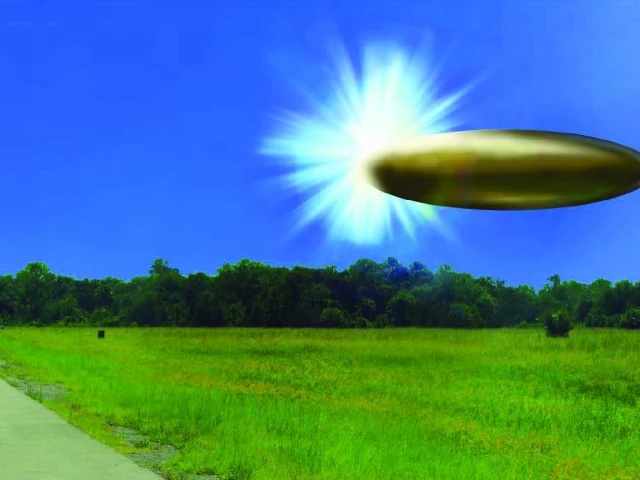
- FBI Lab Graphics — Official renderings showing an apparent ellipsoid bronze metallic object materialising out of a bright light in the sky
Official Statements
"These files, hidden behind classifications, have long fueled justified speculation — and it's time the American people see it for themselves," Hegseth said in a statement announcing the release.
President Trump issued a characteristically direct statement: "Whereas previous Administrations have failed to be transparent on this subject, with these new Documents and Videos, the people can decide for themselves, 'WHAT THE HELL IS GOING ON?' Have fun and enjoy!"
Congressional and Scientific Reaction
The move was welcomed by US Representatives Tim Burchett and Anna Paulina Luna, both long-time proponents of declassifying UFO files. Representative Luna confirmed that an additional tranche of material is expected in around 30 days, signalling continued government transparency on the issue.
Harvard University astrophysicist Avi Loeb commented on the significance of the release, stating: "The files show that UAP are not simply a matter of speculation or public curiosity. The government has collected records." Loeb has been a prominent voice in the scientific community advocating for serious academic study of unexplained aerial phenomena.
Historical Context
The release marks a dramatic shift in government policy toward UFO transparency. For decades, US agencies consistently declined to comment on or acknowledge records related to unexplained aerial phenomena, leading to decades of speculation, conspiracy theories, and intense public curiosity. The establishment of the Pentagon's AARO office in recent years and the regular publication of unclassified reports represented the first steps toward greater openness.
Friday's mass declassification represents a significant acceleration of that transparency effort. The documents are expected to provide researchers, historians, and the public with an unprecedented look at what various US government agencies have documented about unexplained phenomena over the past 78 years.
Global Implications
The declassification is likely to have international implications, as other governments face pressure to release their own records on unexplained aerial phenomena. The United Kingdom, France, and several other nations have maintained their own classified files on UAP encounters, and the US move may encourage reciprocal disclosures.
Scientists and researchers say the release provides a valuable opportunity for serious academic study of phenomena that have been documented by military personnel, pilots, and government sensors across multiple administrations. The availability of primary source documents may help separate verified observations from unsubstantiated claims and move the discussion toward evidence-based analysis.