Trump Safe After Shooting Incident at White House Correspondents Dinner, Suspect Arrested
Trump Safely Evacuated After Shooting Incident at White House Correspondents Dinner
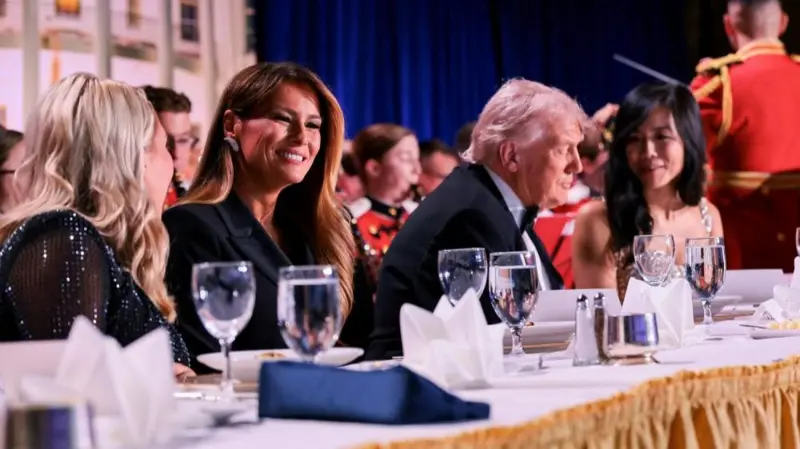
It was supposed to be one of the most celebrated nights on Washington's social calendar. The White House Correspondents Dinner — an annual tradition that brings together the President, senior government officials, top journalists, and high-profile guests for an evening of speeches, humour, and the kind of rare social mixing that rarely happens anywhere else in the American capital. Instead, the evening turned into something nobody in that room will forget for a very long time.
Gunfire broke out at the venue. Panic spread almost instantly. Security teams moved with speed and precision. And President Donald Trump was evacuated from the event safely before the situation was fully brought under control.
By the time the dust settled, the suspected attacker was in custody, one security officer had been struck but protected by body armour, and a room full of some of America's most powerful and influential people was processing the reality of what had just happened in the middle of what should have been a formal dinner.
How the Night Unfolded
The White House Correspondents Dinner is not a casual event. Security at a gathering of this profile — with the sitting President of the United States in attendance alongside senior cabinet members, prominent journalists, and hundreds of invited guests — is extensive, layered, and meticulously planned well in advance. Multiple agencies are involved. Entry points are controlled. The perimeter is secured. Checkpoints are staffed by trained personnel.
Which makes what happened that evening all the more alarming, because the incident did not come from a direction anyone had failed to think about. According to officials, the suspect attempted to breach a security checkpoint — one of the controlled entry points designed specifically to prevent unauthorised access to the event. When he was stopped at that checkpoint, he opened fire.
The sound of gunfire in an enclosed venue filled with hundreds of people produced immediate and predictable chaos. Guests dove under tables. People moved toward exits. The instinct to find cover took over the room almost simultaneously. Journalists who had covered wars and disasters found themselves in the middle of an active security incident at what had been, moments earlier, a formal Washington dinner.
Secret Service agents and other security personnel responded with the speed and decisiveness that their training is designed to produce in exactly these moments. The President was moved quickly and securely. Other senior officials and VIP guests were also escorted to safety. The response, by all accounts, was fast and effective — which is the only reason the evening did not end in something far more catastrophic.
The Security Response — What Went Right
In the aftermath of any incident involving the President of the United States, the first and most important question is always whether the protective mission succeeded. In this case, it did. Trump was evacuated safely, without injury, before the situation escalated further. That outcome does not happen by accident — it is the product of extensive planning, rigorous training, and the kind of institutional discipline that the Secret Service and associated security agencies maintain precisely for moments like this one.
The fact that the suspect was stopped at a security checkpoint rather than gaining access to the main event is itself a significant detail. It means the layered security architecture worked as intended at that level. The breach attempt was identified and confronted at the perimeter rather than inside the venue, which limited the potential for harm to the guests in the main hall considerably.
One security officer was struck by gunfire during the confrontation with the suspect. The fact that this officer escaped serious injury is directly attributable to protective body armour — a reminder that the equipment these officers carry is not ceremonial. It serves a real purpose in real moments, and in this case it did exactly what it was designed to do.
The speed with which the venue was secured after the initial incident — with security teams moving through the space systematically while guests sheltered in place or were directed to exits — also reflects the kind of venue-specific emergency planning that goes into high-profile events of this type. Nothing about the response appears to have been improvised. It looks, from the available accounts, like a security apparatus that knew what to do and did it.
Who Was the Suspect — What We Know So Far
Reports identified the alleged attacker as a 31-year-old man from California. He was taken into custody following the incident, and authorities confirmed that he appeared to have acted alone — meaning this was not a coordinated attack involving multiple individuals or an organised group.
An investigation is ongoing to establish his precise motive and to understand how he came to be at the checkpoint that evening and what exactly he intended to achieve. Those details matter enormously — not just for the criminal prosecution that will follow, but for the broader assessment of what kind of threat this represented and whether any failures in the intelligence or security process allowed it to get as far as it did.
The question of motive is one that law enforcement will be working to answer thoroughly. Political violence in the United States has become an increasingly serious concern in recent years, and any incident involving an attempted breach of presidential security will be examined under that lens regardless of what the investigation ultimately determines. Was this a politically motivated act? Was it the product of a specific grievance? Was it opportunistic? Those questions will take time to answer properly, and it would be premature and irresponsible to speculate before the investigation is complete.
What is clear is that the suspect will face serious federal charges. Attempting to breach a security perimeter at an event attended by the President of the United States, opening fire on federal security officers, and the range of related offences that attach to those actions carry substantial legal consequences. The federal justice system moves carefully in cases like this, but it moves.
The Scene Inside — What Attendees Experienced
For the hundreds of people inside the venue when the gunfire erupted, the experience was sudden, disorienting, and genuinely frightening regardless of how quickly the security response contained the situation.
The White House Correspondents Dinner attracts a particular crowd — journalists who cover the most powerful institution in the world, government officials who operate in environments that carry security risks by definition, celebrities and public figures who are accustomed to significant security arrangements around their public appearances. These are not people who are typically described as easily rattled.
And yet the accounts from that evening describe exactly the kind of scene that any crowd produces when gunfire is heard unexpectedly in an enclosed space. People dove under tables. Chairs were knocked over. Some moved immediately toward the nearest exit while others froze or looked for cover where they were. The sounds of panic mixed with shouted instructions from security personnel trying to direct people to safety.
Within minutes — though those minutes almost certainly felt considerably longer to the people inside — the situation was being brought under control. The suspect had been stopped. The President had been moved. Security teams were systematically securing the space. The immediate danger had passed, even if the shock and adrenaline in the room would take considerably longer to dissipate.
Many attendees were seen taking cover behind tables and chairs as teams moved through the venue. The images and accounts from inside the room serve as a reminder that events like this are not abstract security calculations — they are real experiences for real people, many of whom were simply attending what they expected to be a festive Washington social occasion.
The Event Was Cancelled Immediately
The Correspondents Dinner was cancelled immediately following the incident, which was the only sensible decision given the circumstances. An event of that nature cannot simply resume after an active security incident involving the President has unfolded at the venue. The space had to be secured, investigated, and cleared. Guests had to be accounted for. Officials had to be briefed. The evening was over the moment the shooting started.
The cancellation of the dinner is, in a practical sense, the least significant consequence of what happened. The event can be rescheduled or skipped entirely without meaningful consequence to anyone. What matters far more is the security review that will follow, the investigation into how the suspect reached the checkpoint and whether any gaps in the process allowed that to happen, and the broader assessment of threat levels around the President and high-profile official events going forward.
The White House Correspondents Dinner has a long history as one of Washington's signature annual events. Whether and how it continues in the same format following this incident is a question that the organising association, the White House, and the various security agencies involved will all have views on. The tradition is unlikely to disappear entirely — these kinds of events serve real purposes in the relationship between the press and the government. But the security arrangements around it will almost certainly look different going forward.
Trump Responds — Defiant and Composed
After the situation was brought under control and the President had been confirmed safe, Trump addressed the incident publicly. His response was characteristic of the tone he typically adopts in the face of direct threats — defiant, composed, and explicitly framed as a refusal to be deterred or intimidated.
He thanked law enforcement and the security agencies involved for their rapid and effective response. That thanks was genuine and appropriate — the security personnel who acted that evening performed their jobs well under real pressure, and acknowledging that publicly is the right thing to do.
He also stated that incidents like this will not stop him from continuing to carry out his responsibilities. That message was directed at multiple audiences simultaneously — the American public, political allies and opponents, international observers, and anyone who might have hoped that an incident of this nature would disrupt the functioning of the presidency. The message was deliberate: the work continues.
Presidential responses to direct security threats carry particular weight because they set the tone for how the public processes what happened. A rattled or visibly shaken response amplifies fear and uncertainty. A composed, resolute response — one that acknowledges the seriousness of the incident without dramatising it — helps stabilise the public reaction and signal institutional continuity. Trump's response fit the second category.
The Broader Security Implications
Beyond the immediate facts of this particular incident, there are broader questions that an event of this nature inevitably raises about security in a polarised and volatile political environment.
Threats against public officials in the United States have been a growing concern across multiple administrations and across the political spectrum. The January 6th Capitol riot, the attempted attack on the Speaker of the House's husband, and various other high-profile incidents involving political figures have created an environment in which security agencies are operating with a heightened baseline awareness of potential threats to government officials and public events.
An incident at the White House Correspondents Dinner — one of the most high-profile and closely secured annual events in Washington — will prompt a comprehensive review of security protocols. Not because the response failed — by all accounts it succeeded — but because any incident involving a weapon at a presidential event requires a thorough post-incident analysis to identify any gaps, any points of failure in the intelligence or screening process, and any improvements that can be made to prevent a similar situation in the future.
The fact that the suspect managed to get to a security checkpoint and open fire before being stopped will be examined carefully. How did he get that close? What intelligence, if any, existed about him in advance? Were there warning signs that were missed or not acted on? These questions are not about assigning blame — they are about making the system better and more resistant to the next attempt.
Reactions From Washington and Beyond
The news of the incident spread quickly through Washington political circles and the broader media landscape, generating immediate reactions from officials, journalists, and public figures across the political spectrum.
Expressions of relief that the President and all guests were unharmed came from both sides of the aisle — moments involving direct threats to the physical safety of a sitting president tend to briefly transcend the usual partisan divisions, at least in terms of public statements. Nobody of consequence was publicly celebrating or minimising what had happened.
The journalism community, whose annual event had been the setting for the incident, also responded with a mix of relief, shock, and the professional instinct to cover the story that had just unfolded in the middle of their gathering. The irony of some of Washington's most prominent journalists being simultaneously the attendees and the reporters of a major breaking news story at the same venue was not lost on anyone.
International reactions also came quickly, with governments and leaders expressing concern and solidarity. An attack on a sitting US president — or even an attempted one that came as close as this — is not treated as a purely domestic American matter by the rest of the world. It is a signal about the state of American political security, and it generates attention and response from allies and adversaries alike.
What Happens Next — Investigation and Review
In the immediate term, the investigation into the suspect's background, motive, and the specifics of how the incident unfolded will be the central focus of federal law enforcement. The FBI and Secret Service will both be heavily involved, and the investigation will be thorough given the seriousness of what occurred.
Criminal charges against the suspect will be processed through the federal court system. Given the nature of the offences — attacking a federal security officer, attempting to breach presidential security, discharging a firearm at a protected event — the charges will be serious and the prosecution will be substantial.
The security review of the Correspondents Dinner and similar high-profile official events will run in parallel. New protocols may be developed, existing ones strengthened, and the overall approach to securing this category of event reconsidered in light of what happened.
For the presidency itself, the work continues. Trump made that clear in his public statement, and the machinery of government does not pause for incidents of this nature. The continuity of the executive function is one of the things that the entire security apparatus around the President is designed to protect — and on that measure, the evening's events, as alarming as they were, produced the outcome that the system is built to produce.
Final Thoughts
What happened at the White House Correspondents Dinner was frightening, serious, and a reminder that the political environment in America carries real and sometimes physical dangers for those who operate at its highest levels. An attempt to breach presidential security, shots fired at a federal officer, a room full of Washington's most prominent figures diving for cover — these are not things that belong in a normal evening.
But the outcome — the President safe, the attacker in custody, the security officer protected by his armour, no serious injuries among the hundreds of guests — reflects a security system that, when tested in a real and sudden moment of crisis, did what it was built to do.
The investigation will tell us more about who this person was and why he did what he did. The security review will tell us whether anything needs to change in how these events are protected. And the political environment will continue to be what it is — complex, contentious, and occasionally producing moments that nobody wanted but everyone has to reckon with.
For now, Washington exhales, counts its blessings that the outcome was not worse, and gets back to the work that a city built around government and politics never really stops doing.